Short-finned pilot whale

Short-finned pilot whale

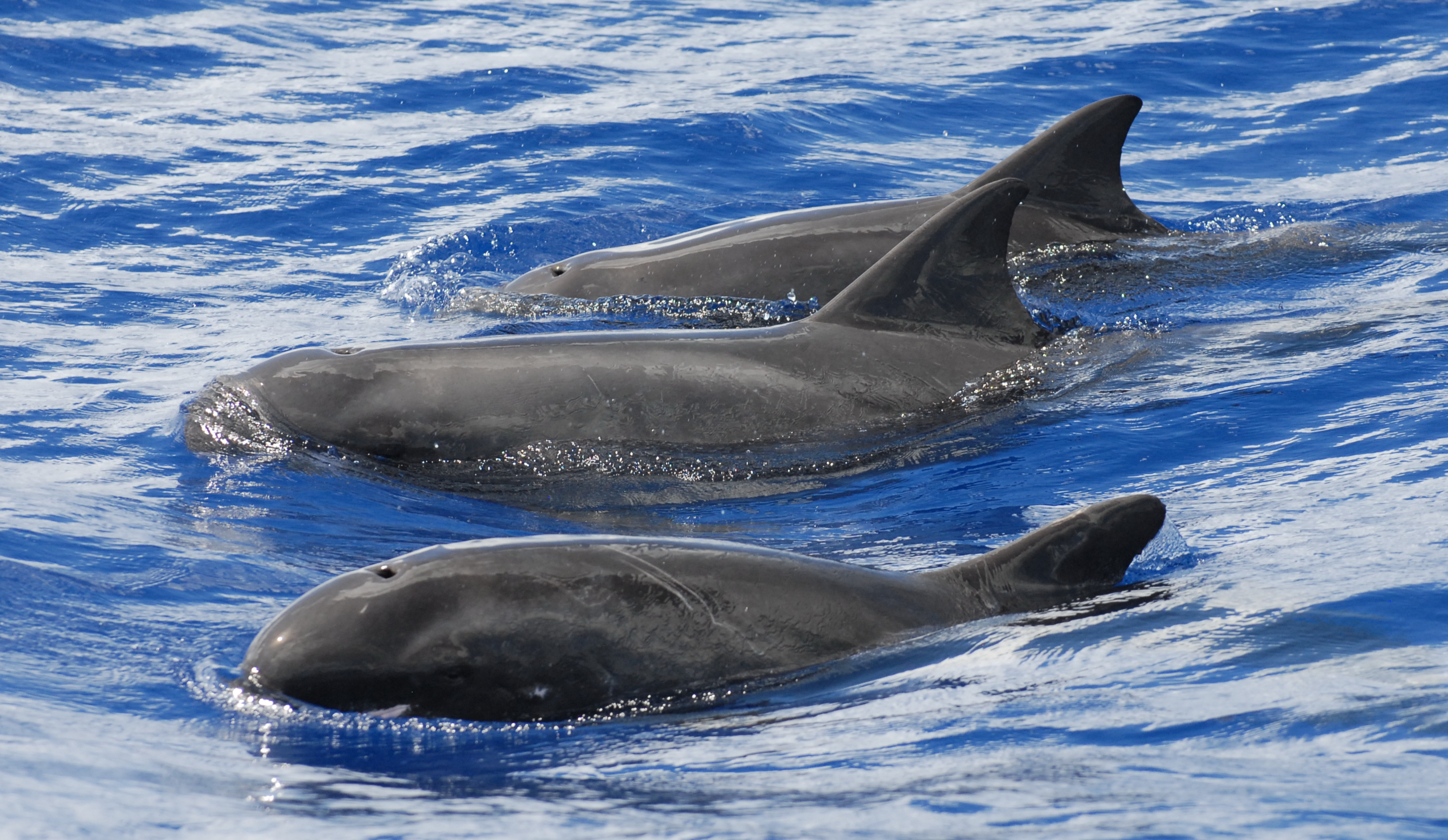
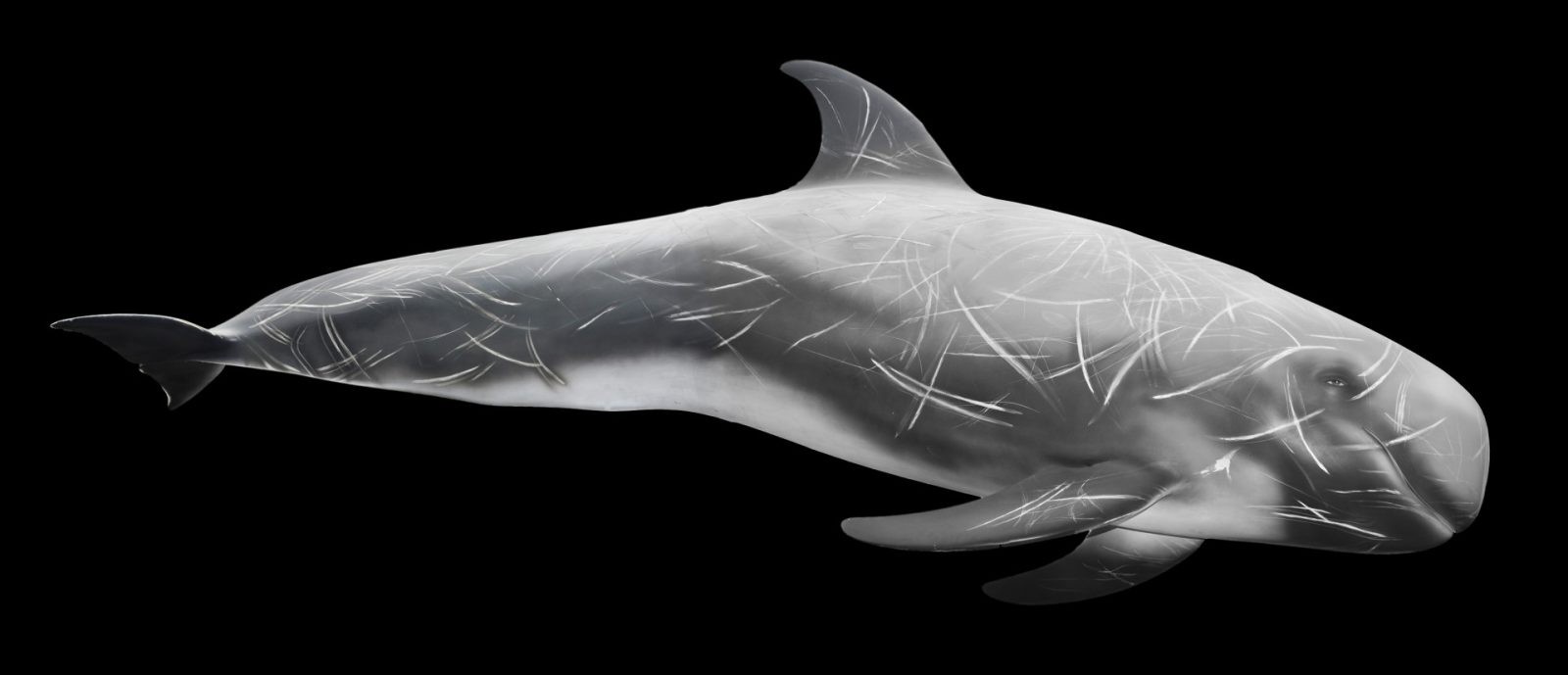
The short-finned pilot whale) is one of the two species of cetaceans in the genus Globicephala, which it shares with the long-finned pilot whale It is part of the oceanic dolphin family (Delphinidae).

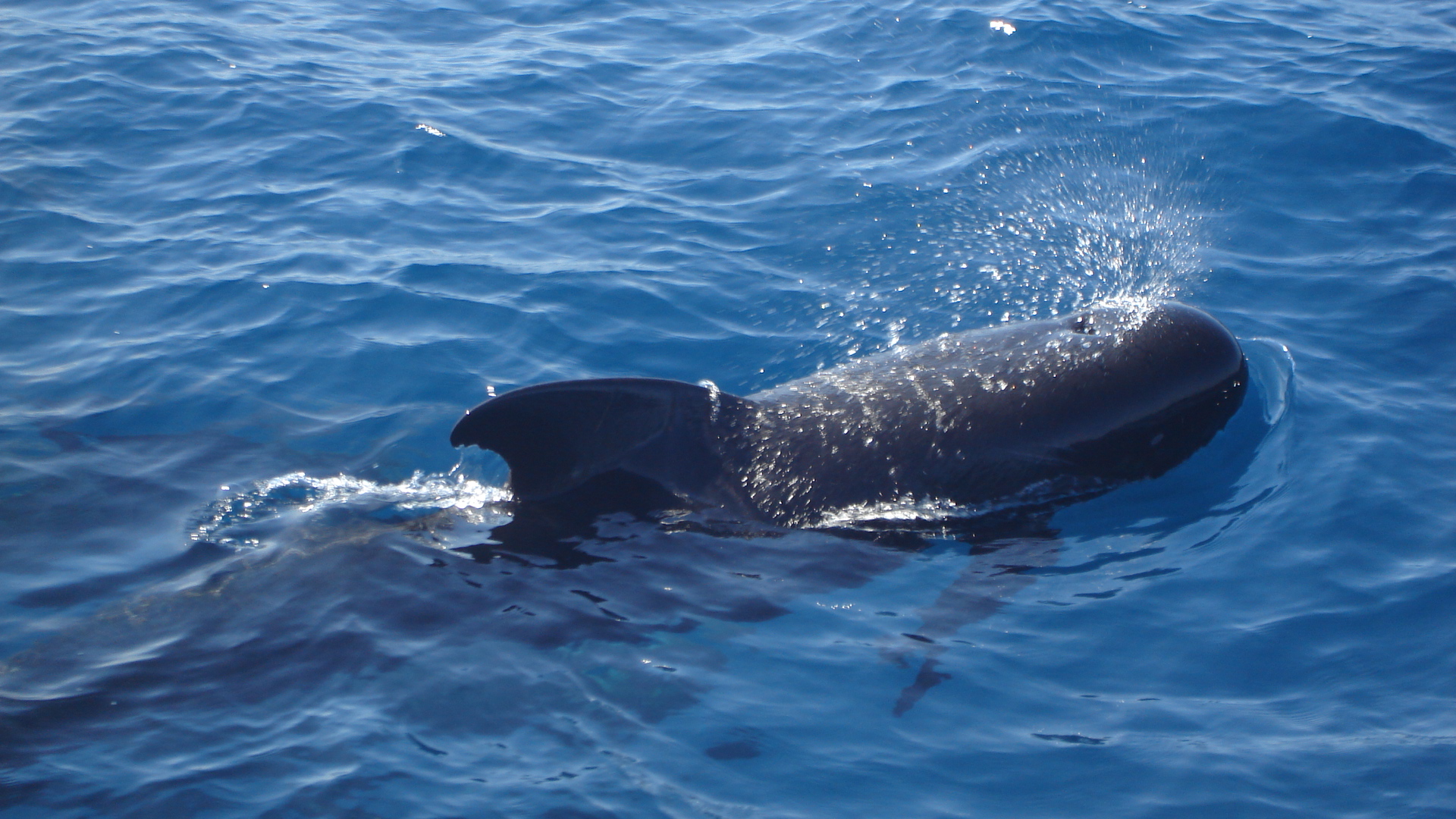
It is found all around the world (avoiding the polar regions) with a global population of about 700,000, though watching them, there appear to be 3-4 distinct populations—two in the Pacific and one in the Atlantic and Indian Oceans. Its range is moving northward due to global warming. In the Pacific, males average 4–6 m  and females 3–5 m. generally stocky with black to dark gray or brown skin. It can be distinguished from the long-finned pilot whale by its  shorter flippers, fewer teeth, and a shorter beak. It is thought to pursue fast-moving squid typically at a depth of 700 m, but the maximum recorded depth is 1,018 m.

The short-finned pilot whale has been reported as being highly playful and social. It typically travels in pods of 10–30 members, usually family, but has been observed moving in groups of several hundred. Like killer whales, it has a matrilineal social hierarchy with an elder female at the head and a sizable post-reproductive lifespan. It is polygynous; females often outnumber males 8:1 in a pod.

Pods are known to mass strand, possibly due to sheer accident, biosonars confused by geomagnetic anomalies, injury from loud military sonar, or disease. It was historically whaled, and is still whaled today by Japan and the Lesser Antilles, but it is protected by several international treaties.

The total of all available abundance estimates for short-finned pilot whales is approximately 700,000 individuals, but populations vary worldwide, and large parts of the species’ range have not been surveyed, therefore actual abundance could be considerably greater than this.

In the western Pacific, population estimates range from 5,300 individuals in Northern Japan to 53,608 in Southern Japan. 7,700 individuals are reported in the eastern Sulu Sea (Philippines), and in the Eastern tropical Pacific the most recent estimate from 2000 gives 589,000 individuals. The resident population in Tenerife, Spain, is estimated at only 350 individuals.

The short-finned pilot whale was listed on the IUCN Red List as Data Deficient in 2008, and remains data-poor in much of its range, especially in the Southern Hemisphere and in large parts of the tropical and warm temperate North Atlantic Ocean.

You will find a video of the species below, and below that a list of any times it has been mentioned on this site (or is in the future). Below that, we will add any links for seeing this animal – as or when we get them.
[smart_post_show id="21141"]

Risso’s Dolphin

Risso's Dolphin by Citron

 Risso’s dolphin is the only species of the genus Grampus. Some of the closest related species to these dolphins include: pilot whales , pygmy killer whales, melon-headed whales, and false killer whales; looking at the pictures, it is perhaps clear that these are similar – they do have similar shapes. 

Risso’s dolphin is named after Antoine Risso, whose study of the animal formed the basis of the recognized description by Georges Cuvierin 1812.

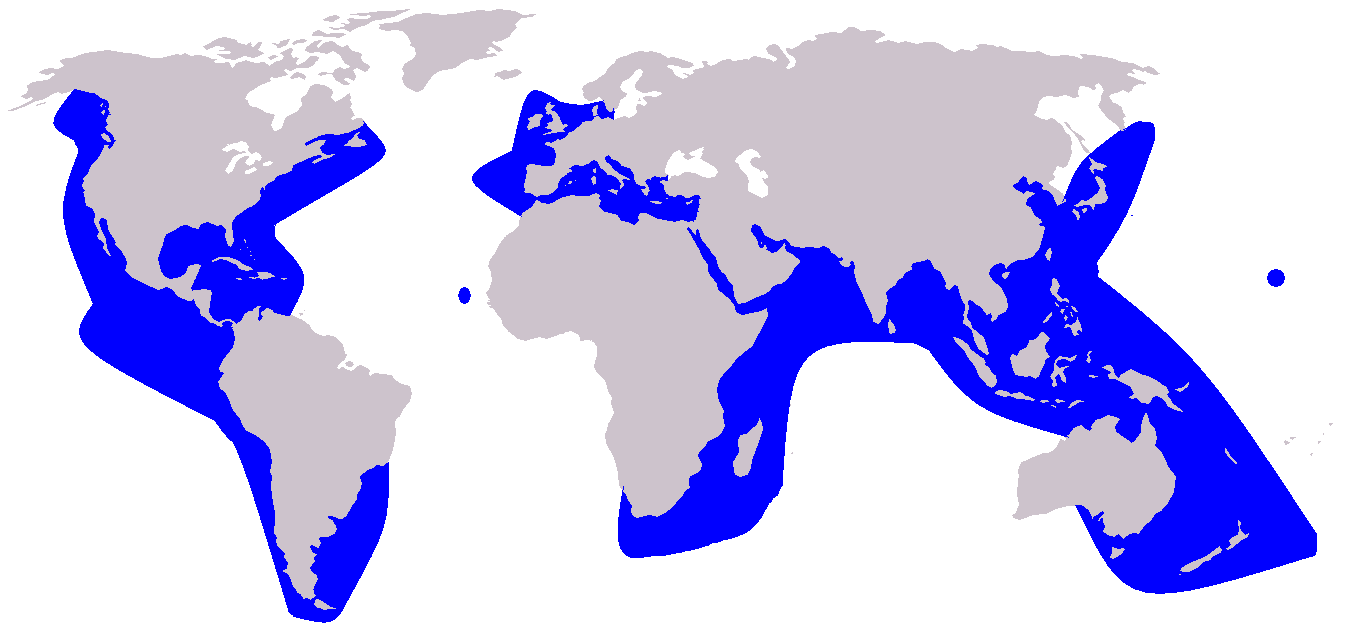
As you can see from the map, their range is pretty large, emcompassing much of the worlds land that lies near land, though not all. Estimated numbers given add up to 300,000 though the number is probably higher, as many areas have not been calculated, and as such their is no global estimate.

The belong to Appendix ii, though they have an unfavourable status.

Below is a video of a risso dolphin, below that is a list of any places where it has been mentioned on this website (or will be in the future) and below that we will try to list places where you can see these animals.

[smart_post_show id="21147"]

One place to see Risso dolphin (not always, but from time to time) is Cardigan bay on the west side of Wales in the UK

Pygmy Killer whale

Pygmy killer whale

The pygmy killer whale is a poorly known and rarely seen oceanic dolphin. It is the only member of the genus Feresa. It gets its name because of several similarities between it and the killer whale (or Orca). It is actually the smallest cetacean which includes the word whale in its name. While there have been occasions when it has been extremely aggressive in captivity, this has never been observed in the wild.

First described by John Gray in 1874, this was only on the basis of 2 skulls found in 1827 and 1874. The next recorded sighting was in 1952 which led to its formal naming by Japanese cetologist Munesato Yamada in 1954.

Pygmy killer whales are most often misidentified with melon-headed whales and false killer whales. For instance, a published paper describing an encounter with a school of pygmy killer whales was later determined to be either a mixture of pygmy and false killer whales or solely false killer whales.

The three species can be differentiated by physical differences between them. One defining difference is, although both species have white around the mouth, on pygmy killer whales the white extends back onto the face. Pygmy killer whales also have rounded-tipped dorsal fins, as opposed to pointed tips. When compared to false killer whales, pygmy killer whales have a larger dorsal fin. Finally, pygmy killer whales have a more clearly defined line where the dark dorsal colour changes to the lighter lateral colour than either of the other two species.

Behavioural differences can also be used to differentiate pygmy killer whales from false killer whales. Pygmy killer whales usually move slowly when at the surface whereas false killer whales are highly energetic. Pygmy killer whales rarely bow ride but it is common in false killer whales.

The small size of this species also causes confusion with other dolphins especially where the frontal head shape of the animals encountered remains unseen. Unlike the melon-headed whale, pygmy killer whales do not normally lift the full face above the water as they surface to breathe so it is not easy to confirm the lack of a bottle. Furthermore, in calmer waters the small bow wave pushed in front of the face looks like a bottle from a distance.

Found in all the world tropical and subtropical oceans, the only ocean with even a rough estimate is the eastern tropical pacific ocean, with an estimate of just short of 40,000 however, this is an estimate and therefore could be way out.

In terms of conservation status, they are least concern (according to the IUCN). Around Sri Lanka they make up around 4% of the by-catch in drift gill nets (one would think that these nets should be banned, or at least a change needs to be found). They can host a variety of parasites, and they are prone to mass strandings, though it is not yet clear why these occur.

Below is a video, below that is a list of anywhere they have (or perhaps will be mentioned in the future). Below that, we will list any contacts that will help you try to see this illusive animal.

[smart_post_show id="21097"]

Long-finned Pilot Whale

Long-finned pilot whale

The long-finned pilot whale is not actually a whale at all. Instead it is a large species of oceanic dolphin. It shares the genus Globicephala with the short-finned pilot whale (as you will see on the whale and dolphin page). Long-finned pilot whales are known as such because they have unusually long pectoral fins. Pilot whales get their name from the original belief that there was a “pilot” or lead individual in their groups. The name for the genus, Globicephala is derived from a combination of Latin (“globe”) and Greek kephale (“head”). The specific name is Greek for “black”. This species has also earned the nickname of “pothead whale” in some places because the shape of its head reminded early whalers of black cooking pots.
There is sexual dimorphism in the species. Females grow to a maximum length of up to 6m (20ft), and a maximum weight of up to 2,500kg (5,500lb). Males are significantly larger at up to 7.6 m (25ft) in length, and weigh up to 4,500kg (9,900lb). This makes the long-finned pilot whale the second largest member of the dolphin family, behind the Killer whale (Orcinus Orca).The long-finned pilot whale is top of the list of animals by number of neurons more neocortical neurons than any mammal studied to date, in fact having almost twice as many as humans.

While they can bee seen in groups of several thousand, they are generally an amalgamation of a number of smaller groups. Generally they belong to pods that lie in size from 20-150, with individual family groups of 8-10 adding together to make this group.

 They make a variety of noises, as well as using echolocation in water too murky to use their eyes. In deep dives, the females on either end appear to make the decisions.

They are Considered least concern, with a north atlantic population of around 780,000 though this includes short-finned pilots whales as it is hard to tell them apart.

Below, you will find a video of these animals. Below that, you will find any articles on this subject that have been written or will be. Below that, I will add any links that will allow you to see this species in the wild.

[smart_post_show id="21089"]

Agile Mangabey

Agile Mangabey

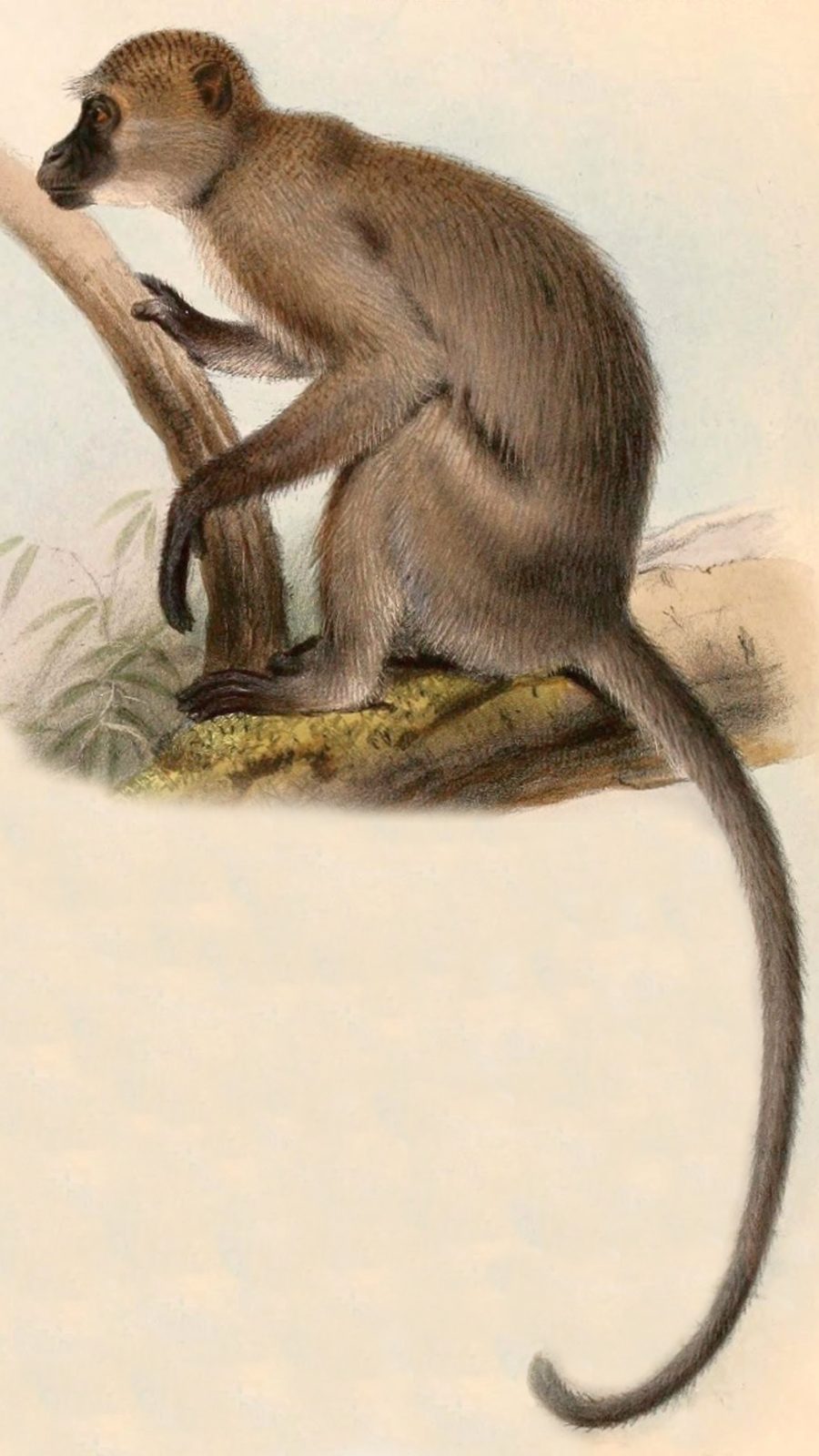
The agile mangabey is an Old World monkey of the white-eyelid mangabey group found in swampy forests of Central Africa in Equatorial Guinea, Cameroon, Gabon, Central African Republic, Republic of Congo, and DR Congo.

Until 1978, it was considered a subspecies of the Tana River mangabey. More recently, the golden-bellied mangabey  has been considered a separate species instead of a subspecies of the agile mangabey.

Similar to other mangabeys, they are active during the day. Although generally tree-living, they do spend a significant portion of their time (12–22%) on the ground, especially during the dry season. It is often heard first, and males have a loud, species-specific call that is believed to be used to space themselves out – in a similar way that wolves operate with howls. Other calls are also used to maintain group cohesion and warn of predators. Group size can be as high as 18 members, led by a single dominant male. Group meetings can be friendly and may involve exchange of members.

Adult males not in groups often travel singly.

Fruit makes up a major portion of the agile mangabey diet. They are known to eat at least 42 different species of fruit. Their tooth structure and powerful jaws allows them to open tough pods and fruits that many other monkeys can not access. Agile mangabeys eat from a number of dominant swamp-forest trees, including Irvingia, Sugar plums when they are fruiting. They also eat fresh leaf shoots from Raffia palm when fruits are scarce. Grass and mushrooms, Invertebrates, bird’s eggs and some vertebrate prey, such as rodents.

As we find links, to help you book to see this species, the links will be added at the bottom of the page.

[smart_post_show id="19206"]

Brydes whale

Brydes Whale

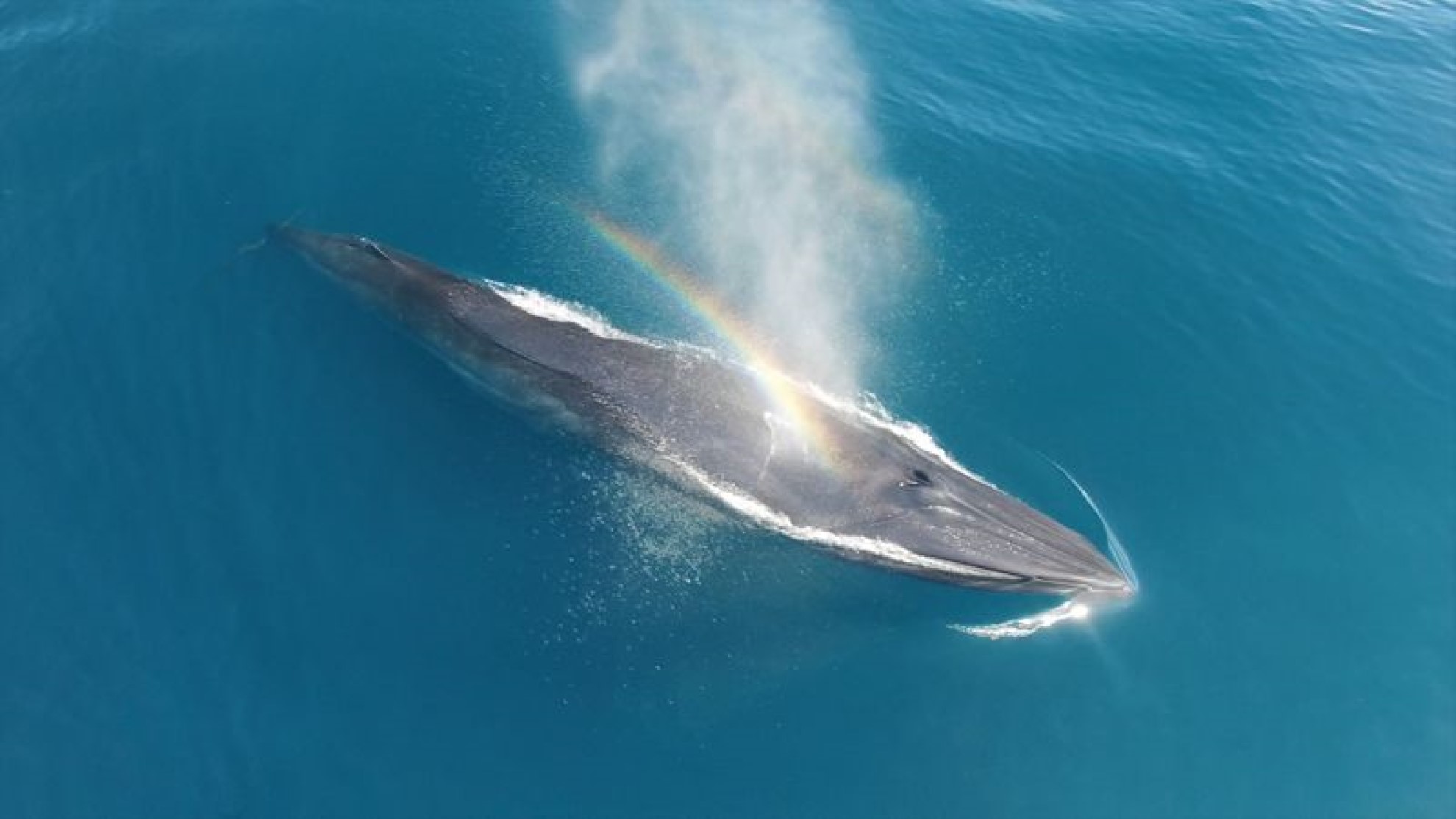
Brydes whale can refer to the species of whale, but it can also refer to the Brydes whale complex which includes 3 or 4 species (brydes whale, Edens whale, Omera whale (which is sometimes referred to as the Pygmy Brydes whale) and the Rice whale.

Worldwide population is around 90,000-100,000. As a result, the entire species is considered least concern. It is therefore essential to work out if the closely related species of whales, are subspecies or separate species.

[smart_post_show id="25202"]

African Nile Crocodile

Nile crocodile

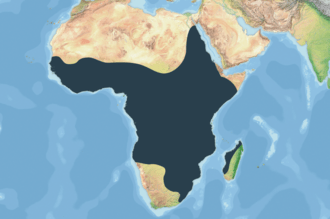
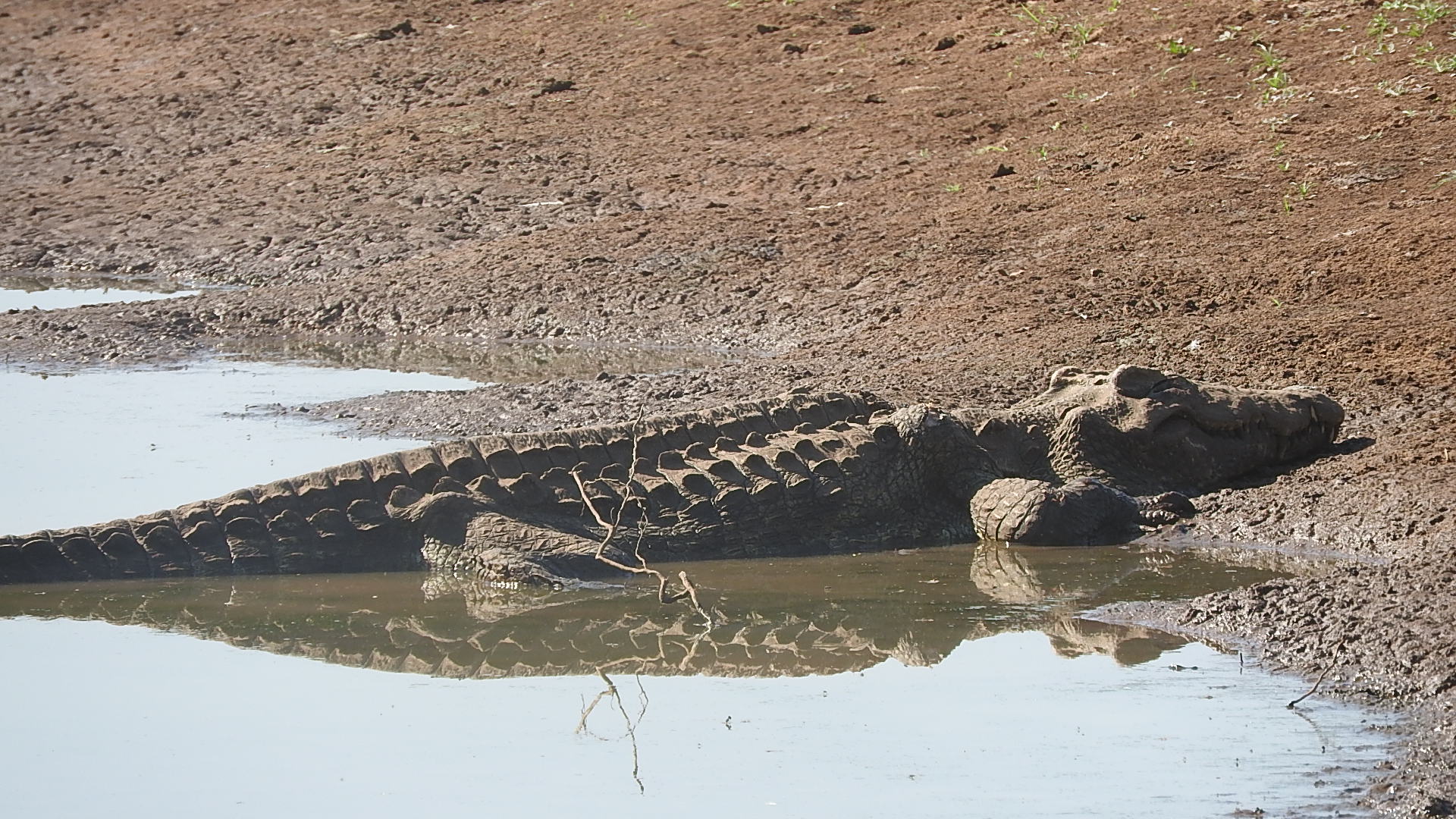
The Nile crocodile is spread widely throughout sub-saharan africa (except for parts

 of South Africa, thought to be natural and not due to hunting). A suggested subspecies is found in western Madagascar, there are 7 such subspecies, though none have been officially recognized.

While it was originally thought to be the same species as the western African crocodile (confusing given its range), it has actually been found to be closer related to various crocodiles from the Americas, particularly the American crocodile. As such, parts of the map above may actually host west African crocodiles exclusively.

The Nile crocodile is considered the second largest on earth, only beaten by the saltwater crocodile of Asia, interestingly, interestingly the saltwater crocodile is also the only crocodilian that has a greater range than the African crocodile. It was thought that the crocodile had arrived on Madagascar in the last 2000 years – after the extinction of the endemic Voey crocodile, but recently a skull was found and dated to be 7500 years old, suggesting that they must have coexisted for millennia.

While rarely venturing into the sea, they can (like all true crocodiles) survive here, and one was found alive 11 miles off the South African coast in the past.

They have been found in the Florida Everglades, presumably after an illegal introduction – there is so far no evidence of them successfully breeding here. It is unclear of their origin or where they came from, though they are genetically most similar to crocs from South Africa.

While they usually only dive for a few minutes at a time, they are capable of holding their breath for 30 minutes of activity under water – impressively, those inactive under water can stay down for around 2 hours. While rapid and effective hunters in the waters and along its edge, they are far less capable away from the water, and it is rare that they hunt away from water, having said this they are known to hunt here, and are incredibly adaptable to any opportunity. They have a surprisingly small stomach, only the size of a basketball.

Only around 10% of eggs will hatch and around 1% will survive to adulthood. Certainly, much of this damage is down to the Nile monitor lizard, which is thought to be responsible for as much as 50% of the eggs on its own, though median sized cats, baboon troops and mongooses all attack crocodile nests with regularity. Once born, crocodiles are even more at risk, both from animals already mentioned, as well as virtually every predatory water bird, from storks and egrets to even pelicans. Unfortunately, the biggest threat are other adult crocodiles which will happily eat young. While the mother does stay around, and aggressively protects her young, there are so many animals trying to snag a meal, many of the young crocodiles are caught during this time.

The biggest threats include loss of habitat, pollution, hunting, and human activities such as accidental entanglement in fishing nets.

Current estimates are around 250,000 to 500,000. In some parts of Africa they are farmed for their hide (their meat is unpleasant).

Their population is less healthy in western and central Africa, being more sparsely spread. This also makes it hard to do an accurate assessment of their status in this part of Africa.

Along with the saltwater crocodile, the African nile crocodile is estimated to kill anywhere from hundreds to thousands of people each year, with attacks generally carried out by larger crocodiles (thought to be over 3.5m). Given the numbers, it is thought that nile crocodiles and saltwater crocodiles are the most successful hunter of humans – far more fatalities than great while sharks. One study suggested, that while the danger of lions was well known, there was a bizarre feeling that crocodiles were not dangerous. The numbers may well be down to the fact that crocodiles live in water – a place where humans are forced to go regularly.

Below this is a list of any articles released on this site, which mentions the Nile crocodile. Below this, is a video of the species, and below this, we will add links of places to see this species, though if you visit wild places, all savannahs listed on the site will have nile crocodiles.

[smart_post_show id="27581"]

Nyala

The Nyala is another spiral horned antelope species which is found in Southern Africa.

nyala – Genus Nyala

Mostly active in the early morning and early evening, they are preyed on by Lions, Leopard and African wild dog. Baboons and raptors will also prey on young members. The main threat to their future survival is a mixture of poaching and habitat loss due to human settlements.

A 1999 estimate suggested that 32,000 of them survived, however current estimates suggest that South Africa has 30,000 in the country, with 25,000 Kwazulu-natal. Mozambique has no more than 3000, while Zimbabwe has around 1000 and Malawis population has halved from 3000 to 1500 and Namibia has just 250.

Today 80% of the population is in protected areas, though they are also popular hunting trophies.

[smart_post_show id=”15044″]

Southern Giraffe

Southern Giraffe

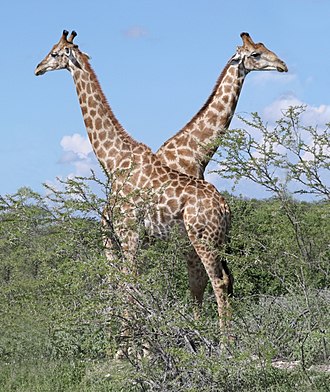
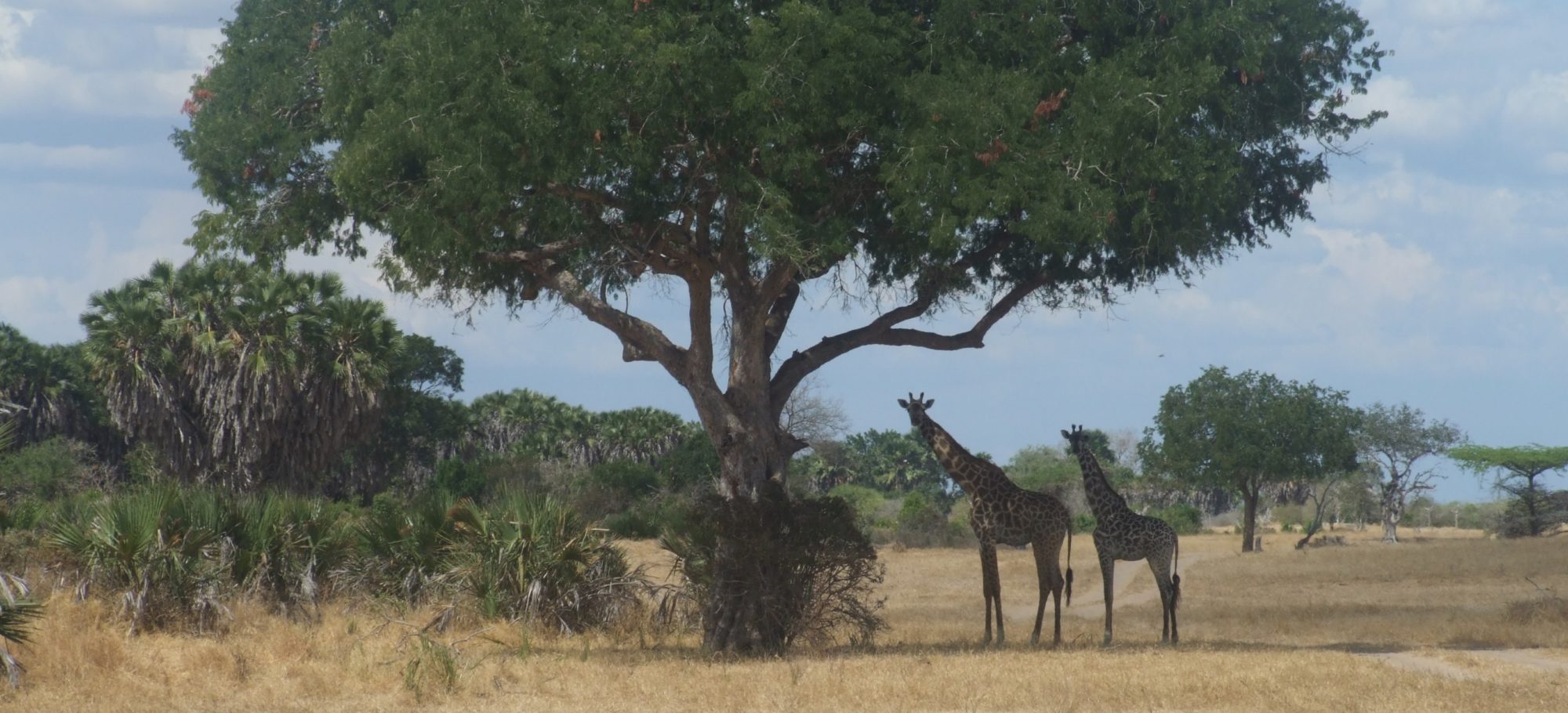
The Southern Giraffe (also known as the 2 horned giraffe) is the most numerous, with a population of around 44,000 (out of the remaining 68,000 giraffes that live in the wild).

Their range includes South Africa, Angola, Namibia, Botswana, Zambia, Zimbabwe and Mozambique. Also, with the majority of their population residing in fortress reserves, such as Kruger, this is likely the safest sub-species.

There are 2 subspecies of this giraffe that are recognized.

  • Firstly the Angolan giraffe which is found in Northern Namibia, South-west Zambia, Botswana and western Zimbabwe. A 2009 genetic study found that the Northern Namib Desert and the Etosha National park population each form a separate sub species (so are not part of this subspecies) with this subspecies also has a white ear patch. Is found in northern Namibia, south-western Zambia, Botswana, and western Zimbabwe. . Around 13,000 animals are estimated to remain in the wild; and about 20 are kept in zoos.
  • The South African giraffe is found in Northern South Africa, southern Botswana, southern Zimbabwe and the south west of Mozambique. It has darker and rounder patches. These patches continue down the legs, getting smaller.
  • There are around 31,500 of this sub-species (almost 50% of the wild population) with just 45 in zoos

[smart_post_show id="14863"]

Sea-Lions

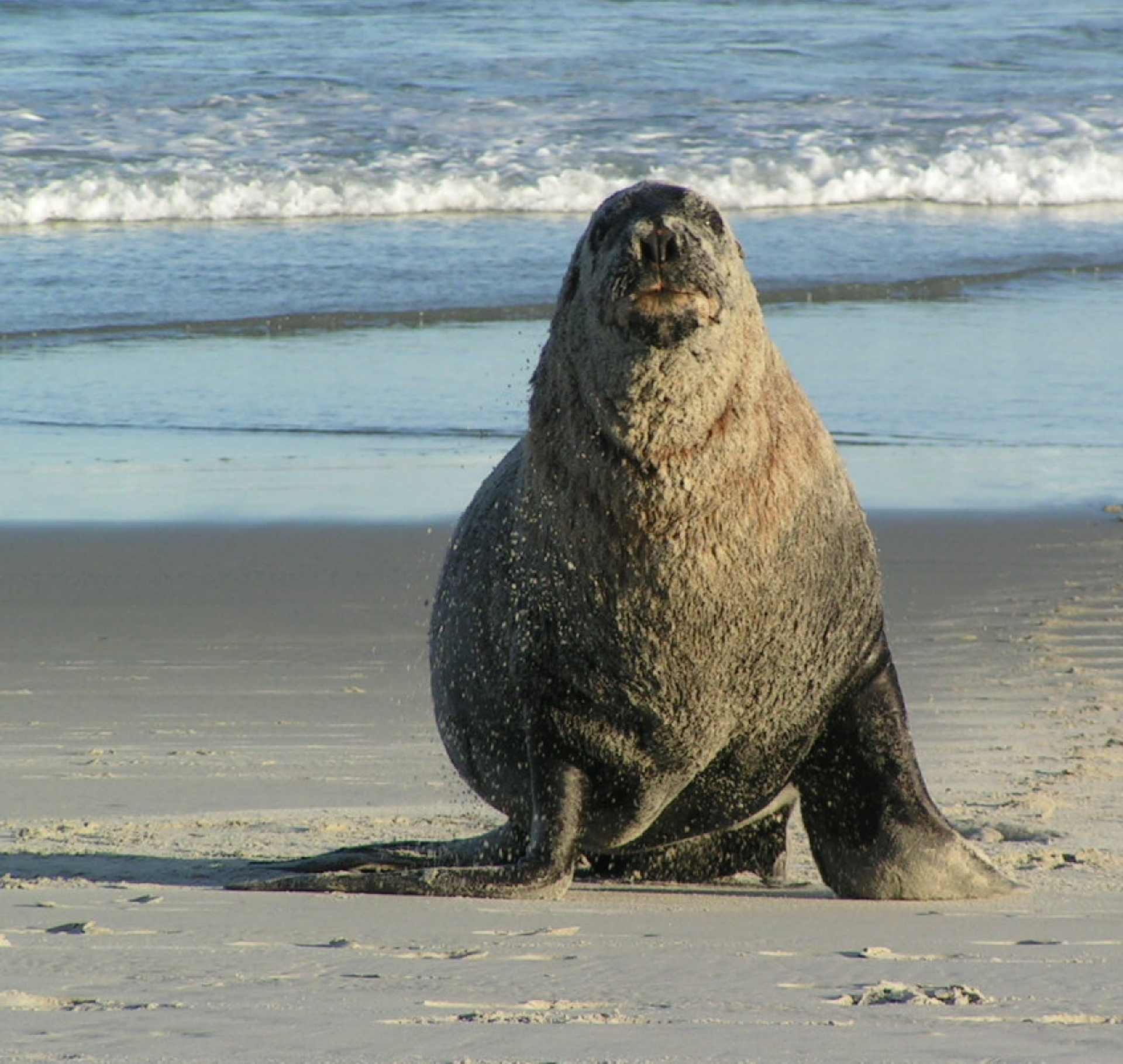
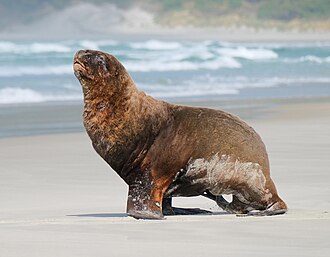
An encounter with almost any wild animal can be something you remember for years. This sealion that came out of the sea on the beach in New Zealand is no different

Sea-lions

There are 6 living species of sea-lion, and 1 extinct. As the interest in these species grows and the links become unwieldy i will split out the separate species, but for the time being I will just have one page for them all – help it to be necessary to split them as soon as possible. 

Sea-lions are pinnipeds with external ear flaps, long fore-flippers, the ability to walk on all fours, short and thick hair, and a big chest and belly. The sea-lions the 6 living species shown below (the Japanese sea-lion is extinct) in five genera. Their range extends from the subarctic to tropical waters of the global ocean in both the Northern and Southern Hemispheres, with the notable exception of the northern Atlantic Ocean. They have an average lifespan of 20–30 years.[2] A male California sea-lion weighs on average about 300 kg (660 lb) and is about 2.4 m (8 ft) long, while the female sea-lion weighs 100 kg (220 lb) and is 1.8 m (6 ft) long. The largest sea-lions are Steller’s sea-lions, which can weigh 1,000 kg (2,200 lb) and grow to a length of 3.0 m (10 ft). Sea-lions consume large quantities of food at a time and are known to eat about 5–8% of their body weight (about 6.8–15.9 kg (15–35 lb)) at a single feeding. Sea-lions can move around 16 knots (30 km/h; 18 mph) in water and at their fastest they can reach a speed of about 30 knots (56 km/h; 35 mph).[3] Three species, the Australian sea-lion, the Galápagos sea-lion and the New Zealand sea-lion, are listed as endangered.

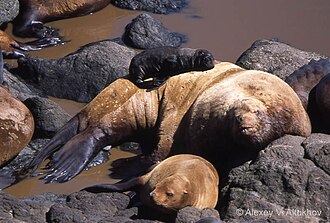
Steller Sea-lion are found on the land of North America and Asia that circle the north pole (map below, credit NOAA). 

They are predated by killer whales, though sleeper sharks and great whites sometimes take young. They eat a variety of foods, include various fish species, as well as octopus and squid. They are fast swimmers, capable of diving to 1500feet, and staying under for 16 minutes

During breeding season, males fight to control a stretch of beach, and females move freely to the place they favour. 

Status: population has fallen 70-80% since the 1970s and so are listed as endangered, around 46,000 individuals, though in recent years, the Eastern population has grown at around 3% a year (in 2013 this lead to its removal from the US endangered species list)


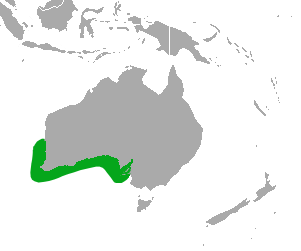
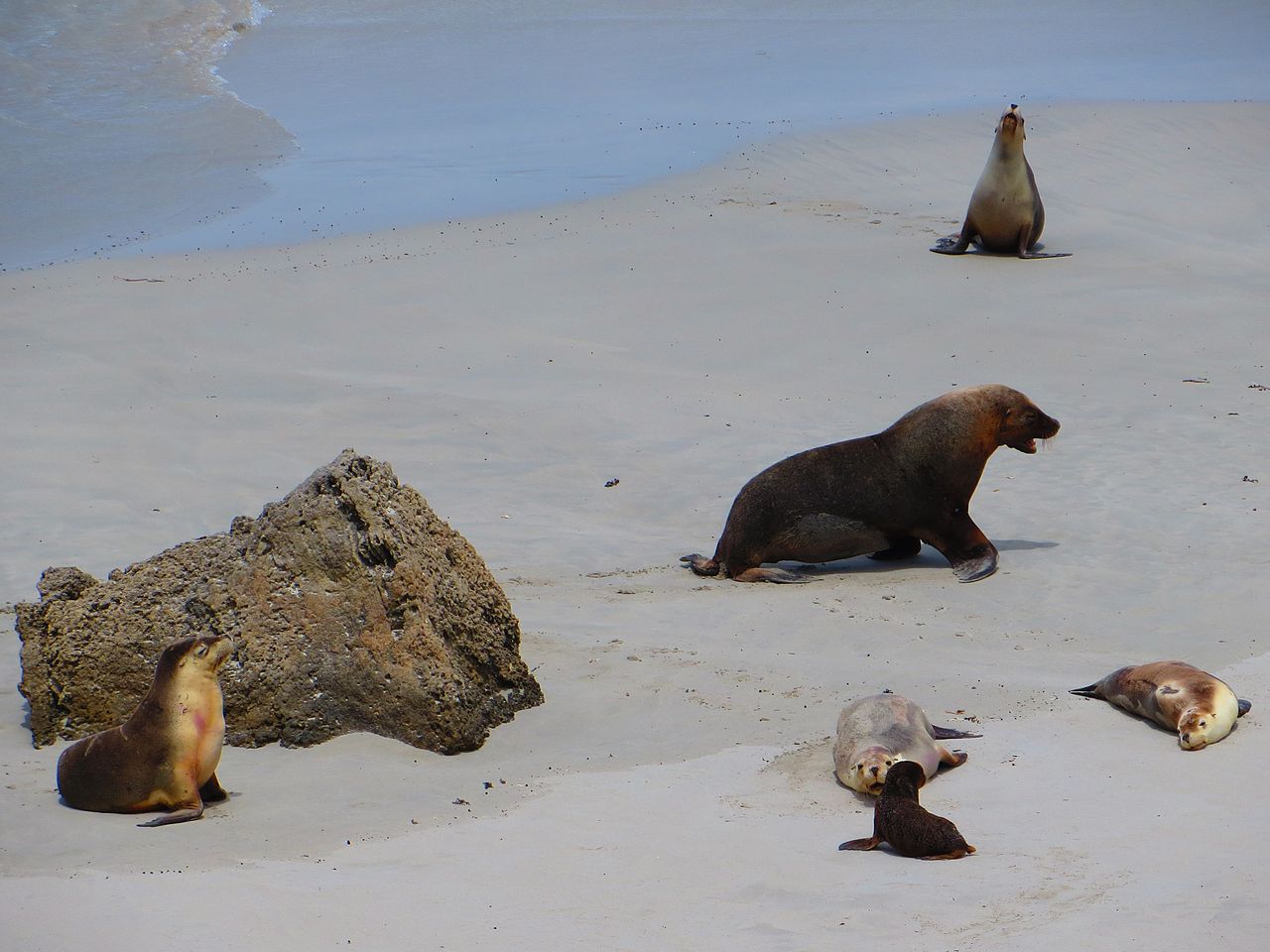
Australian Sea-lion is the only endemic pinniped found in Australia.

They can make a variety of calls, with mothers and young able to pick up each others call in the chaos of a breeding beach. There are currently 66 recognized breeding beaches, though 42% of pups are bred on just 4 of these beaches.

While rare, a bite can require hospitalisation. In both the 1930s and 1960s they were recorded as feeding on little penguins, and this still happens today. Other food includes a variety of fish and even small sharks, in turn, they are hunted by great white sharks and killer whale (orca).

Population was 14370 in 2010 though by 2014 it had fallen to just 6500 mature individuals, though current estimates are 11,200 suggesting a rebound. Still it is clear that they need particular efforts for their conservation. Despite their (relatively) close ranges, the Australian and New Zealand sea-lions do not appear to be closely related. They are considered vulnerable.

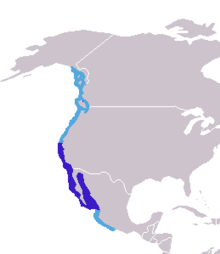
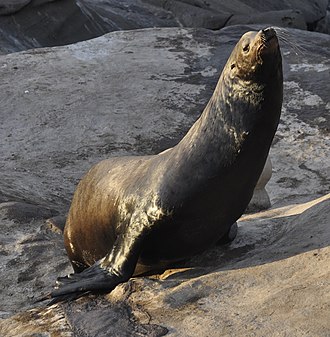
California Sea-lion Are found on the west coast of north America. On this map, the navy blue marks the breeding rance, while the light blue shows the total range that they can be found in. It should be noted, that previously the Japanese and Galapagos sealion were both considered subspecies of the Californian species, but no longer. They can stay healthy, for a time, in fresh water, and have been seen living for a while in Bonneville dam – 150 miles inland.
They see (mostly in blue/green) and hear well, as well as being able to sense nearby, with their whiskers. They generally eat fish, squid and occasionally clams. They have been seen cooperating with other sealions, or indeed dolphins porpoises and sea-birds in their hunting techniques, though exploitation is also common.

There are 5 relatively distinct populations. Several sealions have reached Japanese waters in recent years, and this is the most likely origin, as such  it could return to Japan on its own. 

It is considered least concern with 238,000-241,000 individuals and increasing over time.

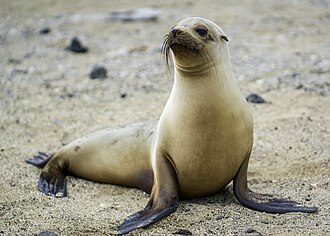
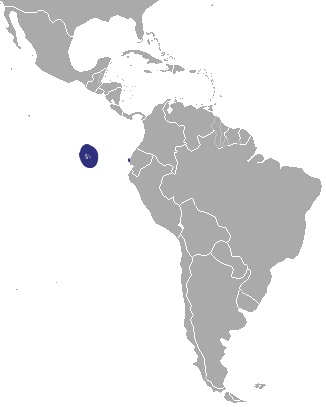
Galapagos Sea-lions Found on all of the Galapagos Islands, as well as (in smaller numbers) on Isla de la Plata, which is just 40km from Puerto López a village in Ecuador. There have also been recorded sightings on the Isla del Coco which is 500km southwest of Costa Rica (and 750km from the Galapagos). These are not regular, and so have been considered vagrant. It is of course possible that historically they roamed here, but we cannot say.

They are the smallest species of sea-lion, and can often be seen gliding through the water, or sunbathing on the beach. They measure 1.5m-2.5m and weigh between 50 and 400kg.

Much of their diet is made up of sardines. Interaction with humans is usually negative, and feral dogs often form packs, and can then attack the sealions.

The population tends to bounce between 20,000 and 50,000 and they are currently classed as endangered


New Zealand Sea-lion (formerly known as the Hooker sealion) is native to south island, though before 1500 it is thought that it was also found on north island. They tend to breed on Subarctic islands of Auckland and Campbell (99% of the pups are born in these islands). In 1993, sealions started breeding on South Island again for the first time in 150 years.

Genetic evidence suggests that until 1300-1500 there was a mainland subspecies, which was wiped out by the Mauri’s and has been replaced by members from the sub-Antarctic population.

As well as eating fish and crustations, they will take new Zealand fur seals as well. They are hunted by great white sharks, and in a survey 27% of adults had scars from near misses. While south American sealions are hunted by orca (with them famously beaching to catch them) they do not appear to do this around New Zealand. After the birth of their pup, females move inland as much as 2km to avoid males, storms and even parasites.

They are thought to number 12,000 making them the rarest sealion. They are also the most distinct being part of the Genus Phocarctos, and are listed as endangered.


South-American Sea-lion

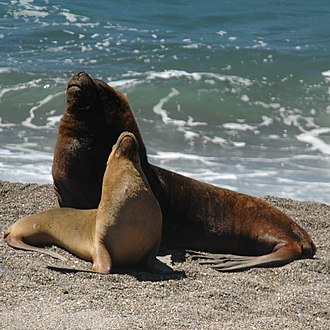
Also known as the Southern sealion or the Patagonian sealion. They have been recorded going as far north as Ecuador, though not yet breeding there. They eat fish, as well as squid and octopus, and have even been observed predating penguins, pelicans and South American fur seals.

Males set up territories, but after the arrival of females switch to protecting them. Having said this, one population in Peru have a different set-up where males perform, and females choose a mate, and are free to move freely. This may be in result to the warmer climate, which means the females make regular trips into the sea.

The total population is estimated at 265,000. They are declining in Patagonia (Argentina) and the Falklands but increasing in Chile and Uruguay. In the 2013 El nino many Peruvian sealions died. They are still regularly killed by fishermen, both for damaging equipment and stealing fish.

They are listed as least concern


As we gain contacts each picture above will become a link to a page for the specific species – for now, all species will be looked after by this page. If you are a wildlife guide or live nearby and want to be able to host (as a hotel or B&B or campsite) and would like to be listed do get in touch. Our aim, is to give people all the information and links on one page, so that they can book everything in one go – making it easy, and therefore more people undertaking these sort of trips.

Sea-lions can be specifically searched out, but it is also possible to have a surprise encounter with one.

One of my most memorable encounters with any wildlife, is an encounter with a New Zealand sealion.  We had simply gone for a walk on the beach, and at some point, we saw the sea-lion coming out of the sea. This huge male slowly made its way towards us, and when about 10m away it lay down in the sand, threw sand all over itself and went to sleep.

To return to the Pinniped page click here

[smart_post_show id="22073"]
See Animals Wild

Read more news

Join as a wild member
to list your wild place & log in

Join as an ambassador supporter to
support this site, help save wildlife
and make friends & log in

Join as an Associate member
to assist as a writer, creator, lister etc & to log in

List a wild destination

List a destination in
the shadow of man

List a hide for animals more easily seen this way

Highlight some news
missed, or submit a
one-off article

Browse destinations for fun or future travel

Temporary membership
start here if in a hurry

Casual readers and watchers