The common raccoon dog (also known as the (Chinese or Asian racoon dog, to distinguish it from the Japanese racoon dog)is a species which is found in east Asia. Although named for its facial markings, it is not closely related to raccoons and, although part of the dog family, it is more closely related to the fox.
This animal has been widely introduced in Europe due to regular escapes from fur farms.
Common raccoon dogs are omnivores that feed on insects, rodents, amphibians, birds, fish, reptiles, molluscs, crabs, sea urchins, human garbage, carrion, and eggs, as well as fruits, nuts, and berries.
Wolves predate them, and eat many in the spring. In Russia, wolves can account for as much as 2/3 of the deaths. Other animals like badgers and lynx will kill them, but generally do not go out of the way to do so. A range of birds of prey also target them.
They are the only canid to hibernate. There are around 4 subspecies. The Japanese racoon dog was thought to be a subspecies until recently when it was elevated to being its own species. They are one of the species that is thought to be have spread covid, and there are other illnesses that their introduction has caused to arrive in new countries.
The Pampas fox is also known as the grey pampean fox, Pampas zorro, Azara fox or Azara zorro. It is a midsized (non) fox as all south American foxes, which are more closely related to the wolf and jackal.
Pampas fox
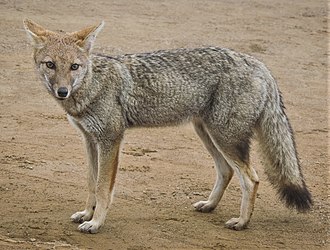
The Pampas fox resembles the Culpeo or Andean fox in appearance and size, but has a proportionately wider snout, reddish fur on the head and neck, and a black mark on the muzzle. Its short, dense fur is grey over most of the body, with a black line running down the back and onto the tail, and pale, almost white, underparts.
The Pampas fox can be found in northern and central Argentina, Uruguay, eastern Bolivia, Paraguay, and southern Brazil. It prefers open pampas habitats, often close to agricultural land, but can also be found in montane or chaco forest, dry scrubland, and wetland habitats. It is most common below 1,000 m (3,300 ft) elevation, but can inhabit puna grasslands up to 3,500 m.
They are occasionally hunted for their fur, or to avoid livestock deaths, however thus far this has not impacted population.
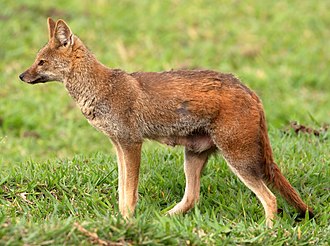
Also known as Hoary zorro, its Brazilian name means little meadow fox. It primary feeds on insects,
Hoary fox
The Hoary fox is generally nocturnal and usually solitary except during the breeding season. They survive for the most part on insects such as termites, dung beetles and grasshoppers. They will also eat rodents, small birds and fruit. Their home range varies widely depending on how much food is available. An example is one adult in Southern Bahia whose home range covers 950 acres, however in the pastures of Minas Gerais a breeding pair with 5 young survived on 1130 acres, and in Eastern Mato Grosso 2 breeding pairs shared 120 acres.
They are mostly native to Southern central Brazil. We hope in time to list places to see this animal, but for now, below is a video from Mongabay about this small canid.
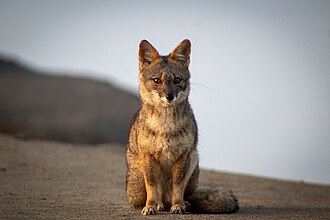
Also known as the Peruvian desert fox, or the Sechuran zorro. It is a small canid from South America – closely related to the other South America false foxes (or zorro). It is found in the Sechura desert in the north-west of Peru, which is where it gets its name from. Its range is from Southwest Ecuador and west Peru.
Genetic analysis shows that it is closely related to the Darwins fox.
It is nocturnal, and mostly solitary. it is an opportunistic hunter. The animal is considered low risk in Ecuador, and hunting is banned without a license in Peru.
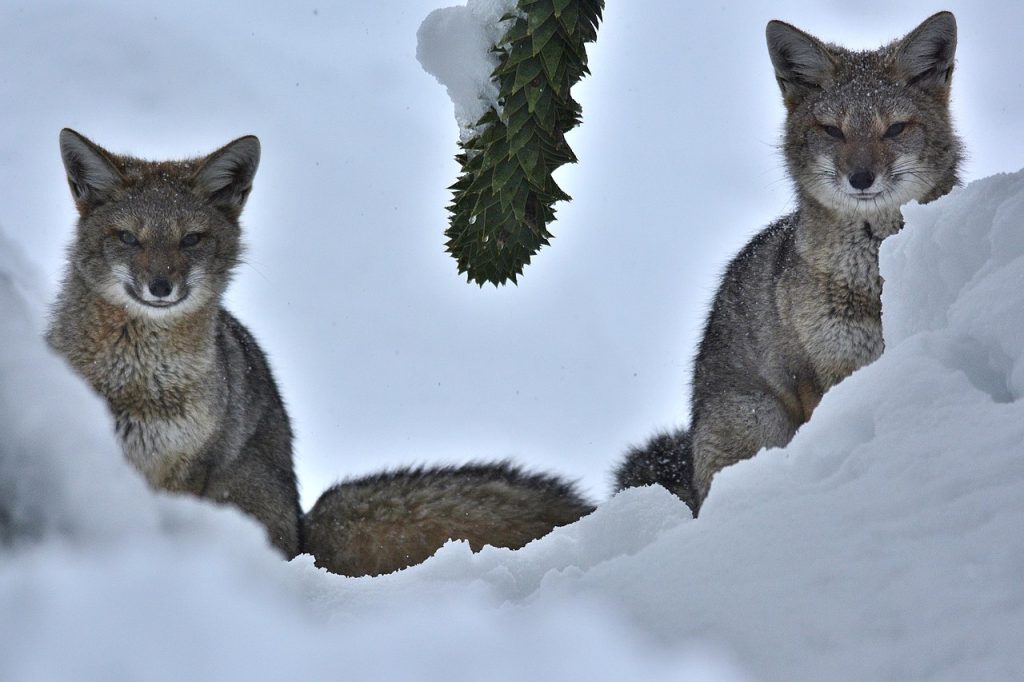
The South American gray fox is also known as the Patagonian fox, the chilla or the gray zorro.
South American Gray fox by Gabriel Barrera Maffioletti
As you can see, the South American gray fox, looks very like the red fox that we are used to, but being grey. It is a similar size,
It is found in the Southern half of South America in Argentina’s Western half, as well as the majority of Chile. There have also been some unconfirmed sightings in Peru.
The South American gray fox live in a range of habitats, from the warm, arid scrublands of the uplands and the cold, arid Patagonian steppe to the forests of southernmost Chile.
In places this foxes range overlaps with the Cupeo fox.
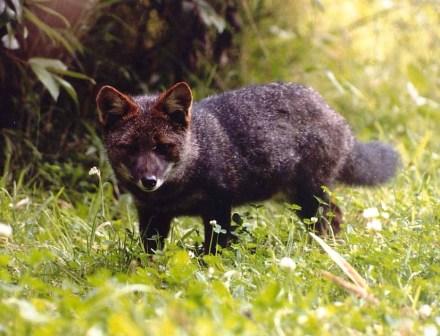
Darwins fox is always known as Darwins zorro, zorro chilote or zorro Darwin and is an endangered canid. It is found in a few places in Chile and san pedro island off the coast (these two populations have been split for 15,000 years since the melting of a glacier, and are now genetically distinct enough to be considered subspecies. It tends to live in forests in its range,
The Darwins fox has a wide ranging diet. In dense forests, the fox hunts mammals, reptiles, beetles and invertebrates. Elsewhere it eats fruits berries and seeds, Birds and amphibians are also eaten if the opportunity arises, it will also eat carrion although most of its diet is live animals and fruit – as such it is mostly an omnivore, and sometimes a scavenger.
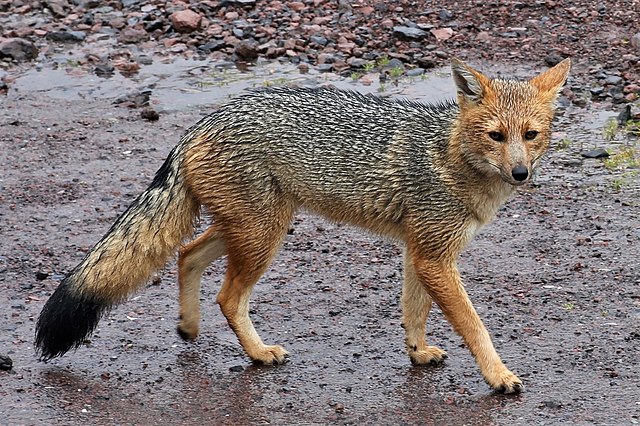
Also known as the Culpeo zorro, Andean Zorro, Andean Fox Paramo wolf, Andean wolf or the Colpeo fox, this canid is actually not a fox, but more closely related to wolves and jackals. It should be noted, however, that due to convergent evolution, it does look more like a fox. This is the same for all of the South American foxes.
Culpeo taken by Vakovlex, Alexey from Moscow, Russia
Mostly it eats rodents, rabbits, birds and lizards, though it will also eat plant material and carrion. They will occasionally predate Andean flamingos as well as baby vicuna. It will also occasionally take sheep which has lead to it often being hunted or poisoned. In some areas it has become rare, but across its range there is no threat of extinction.
It has been domesticated by the Selk’nam people of Tierra del Fuego, which has resulted in the Fuegian dog, which became extinct around the turn of the 20th century.
Domestic cats are thought to have been first tamed back around 10,000 somwhere in the middle east. Unfortunately, as this is the cat that makes up the worldwide domestic cat population (almost exclusively) in many regions like Scotland, while reduction in numbers made specific subspecies of wildcat endangered, it has often been hybridisation that has pushed them over the edge.
There is little point in showing a map of the world, as they are found in almost every human population. It is thought that there are at least 200 million across the globe
Domestic cats are thought to have been tamed in Israel, which has unfortunately meant that this species of wild cat is now spread across the globe – many local species of wildcat have become extinct through hybridisation, the British wildcat is just one such example. There are now only pure British wildcats in captivity, and while there are still quite a few living wild in Scotland they have Asiatic wildcat features. This has happened in many places and solutions are not yet forthcoming.
While unfortunate, there is still work being done. In the UK there are plans to clear a peninsular of domestic cats, and re-establish a wildcat population. Only in situations like Scotland is hybridization likely, the most common reaction to a wildcat meeting a domestic cat is for the wildcat to kill the domestic cat. I hope to live to see the wildcat roaming Scotland once more, but we will se what happens.
[smart_post_show id=”11927″]
They are not hard to see if you are in the right place. I have seen them in Africa, take a night drive in almost any nature reserve. Links will be added below.
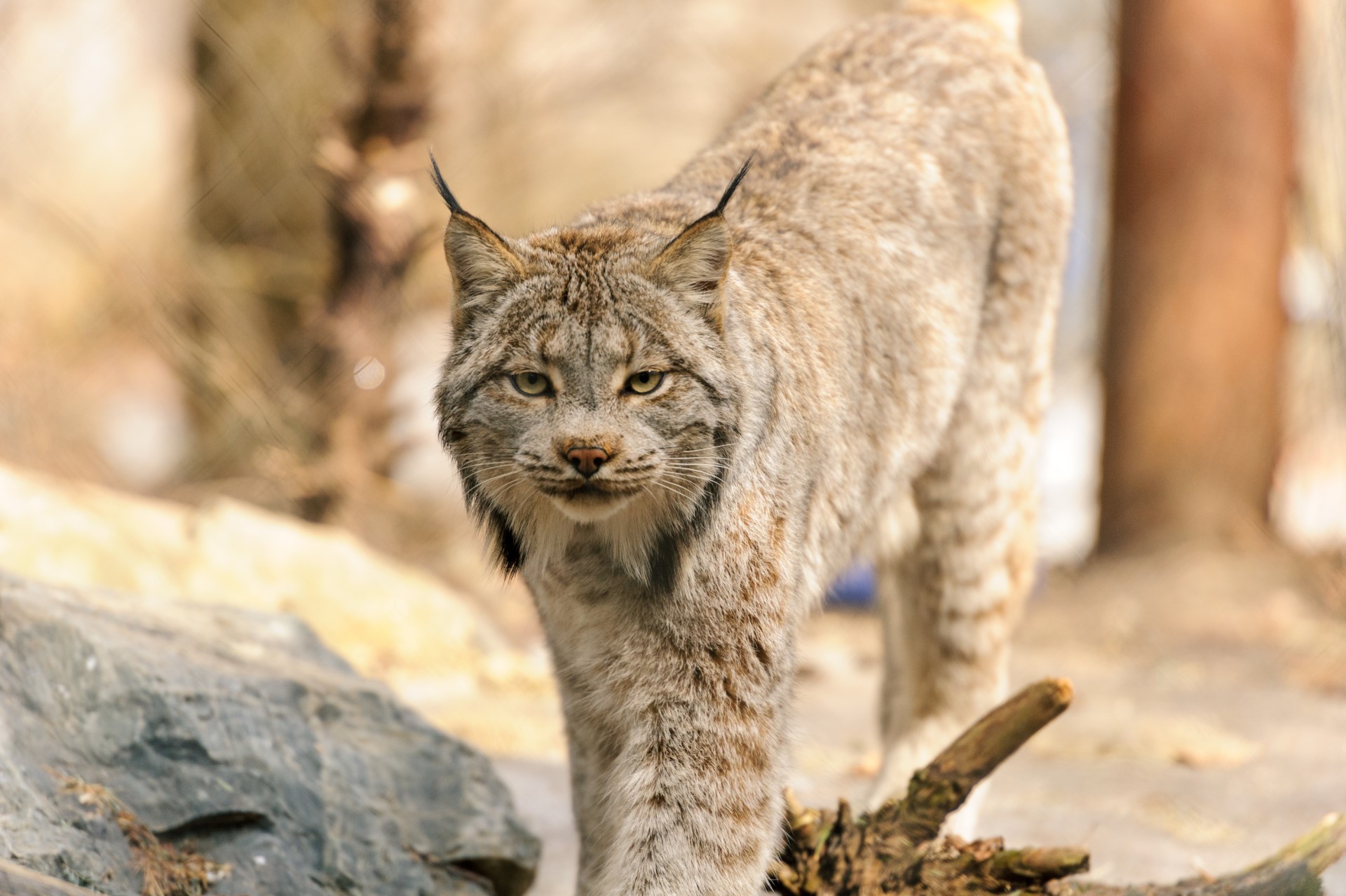
The Canada lynx is one of 2 new world species, and is found through much of Canada and Alaska, throughout the Boreal forests of spruce and fir. They are hunted but the harvest is worked out on the basis of the population, so it rises and falls quite a lot. Climate change is effecting its northern range, and unfortunately is bringing this cat and the bobcat into more common contact, leading to an increasing number of hybrids along the area that they meet. There are thought to be 10-12 thousands of the Canada lynx across its range.
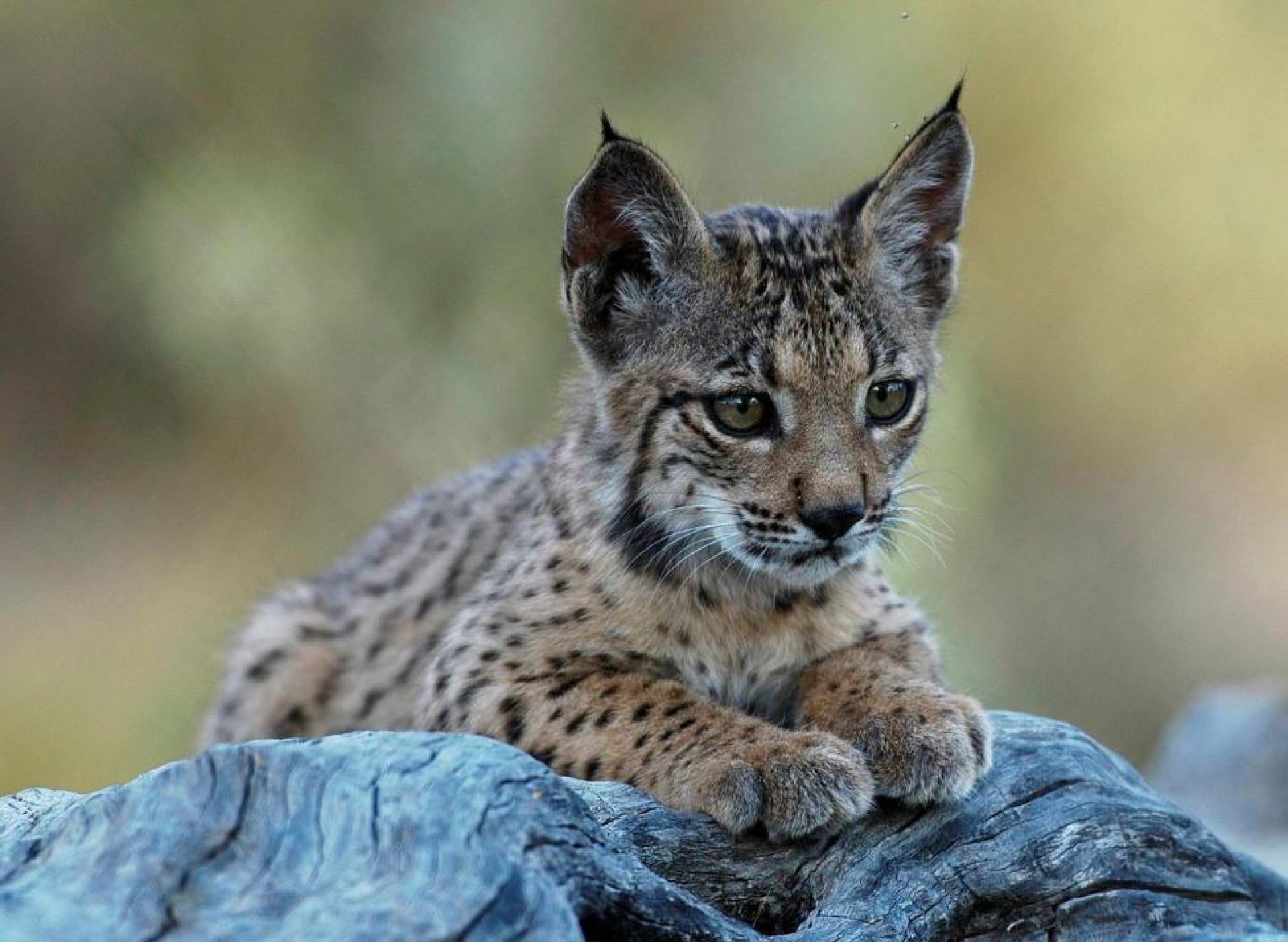
Iberian Lynx: Once found throughout the Iberian Peninsular as well as much of France: The Iberian lynx population fell to just 94 cats in two populations (23 years ago). Through intensive work the population has returned to 1668 as of May in 2023. This is currently restricted to just the south and west of the Iberian peninsular, but is likely to slowly expand its range North and East.
It is fantastic to see the Iberian Lynx returning to places that it was found in the past, however, what is clear is that as the human race, our current understanding of science allows a great deal of power, and it is scary to think that the introduction of an illness to kill rabbits could come so close to exterminating all Iberian Lynx.