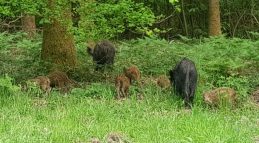
Wild boar continue to spread across the UK, arrive just a mile from where i live (Still sorting issues, but progressing)

I have missed writing regularly, but have been having some issues with this website. I am hoping that in the near future these will be resolved, and allow the website to reach some of its potential – however for now, back to this article.

The UK is recognized as one of the most nature depleted places on earth. never the less, there is wildlife in the shadow of humans. A very wide range of wildlife has been lost, as humans have not left the space – this is causing us issues, not least because there are no apex predators left.

Wild boar, however, were accidently released – they were bred for meat, and between a variety of escapes and intentional released populations, a wild population has been established in the UK. Domestic pigs are descended from wild boar – it is thouoght that they were domesticated twice, once in the near middle east around 8500 years ago, and again in China around 6500 years ago (though it should be noted that these dates are still pretty unclear. 8500 years is not a long time in genetic evolution, and as such they are still capable to interbreed, even though there is a significant difference in how these two groups live.

There is an estimated 2600 wild boar living in the UK. The largest populations are listed below, though it does not account for all of them

  • Forest of Dean: This area has the most established and largest wild boar population in the UK. The population is estimated to be around 1,200 animals.
  • Kent/East Sussex: This area has a population of 250-300 wild boar.
  • West Dorset: This population is estimated to be over 50 animals.
  • North Devon: This area has a smaller population, estimated to be between 50 and 100 wild boar.

Wild boar are incredibly important for the health of forests – wild boar turn soil in their search for roots and tubers, and this is perfect for the growth of new seedlings. Boar rootling areas are often full of tree saplings and shoots growing together. It is something that has been missed for a very long time, and the health of forests that the boar returns to is greatly improving.

The area that I live in, has a great deal of army land, and therefore, I believe that the area could support hundreds of boar, if not more.

This individual boar, is likely to be a young roaming male, and usually, the first visitor does not settle within an area, however, females also roam, and should a male and female meet, they are likely to become a breeding pair, and at that point the population can grow fast as a breeding pair (when they have some domestic pig genes in them) potentially having 3 litters of 10 or more a year.

Will a breeding population be established around here? It is still for the time being, chance, however at this breeding rate, it is quite conceivable for boar to be back across the UK within the next couple of decades. Pure wild boar would be better, however adaption back to living in the wild will likely slow their breeding rate relatively fast.
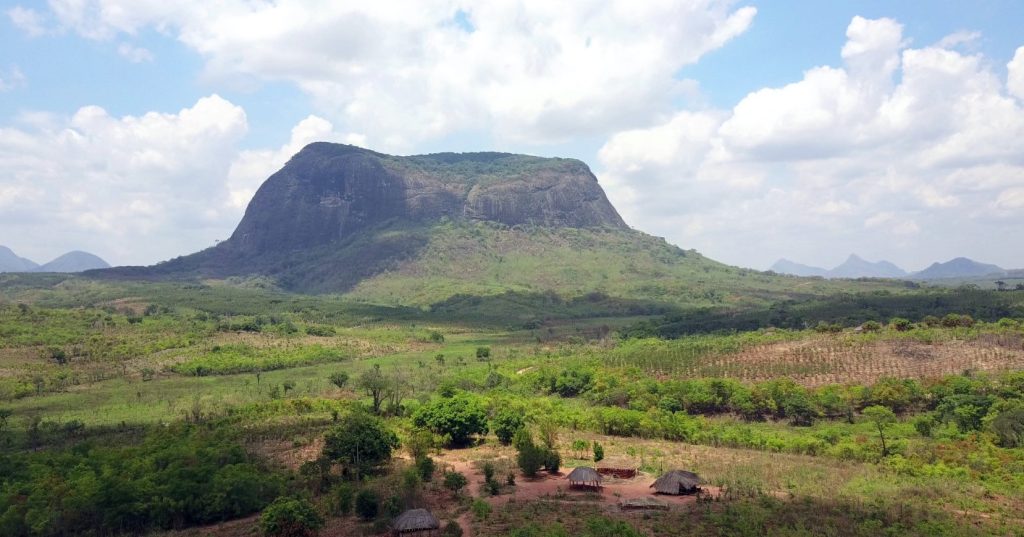
‘Sky islands’ in Africa are producing more new species than anywhere else

Sky islands like this one Mount Lico in Mozambique

Sky islands are found across much of Africa. Our experience of sky islands, occurred within the Udzungwa national park in Tanzania. This national park protects a large portion of the Eastern arc mountains. – a chain of mountains which run across Eastern Tanzania.

Africa started drying out around 5500 years ago, and much changed at this point, including a great expansion of the Sahara. However, what is relevant here, is that in many parts of the continent, this caused the rainforests to retreat. More rain falls on higher ground, so you were left with a situation where the tops of hills and mountains remain forested, but the valleys become savannahs. Perhaps one of the most notable effects of this, was to split the worlds mountain gorillas into two populations, one in the Bwindi impenetrable forest in Uganda and the other in the Virunga ecosystem. At their closest point, these two protected areas are only 20km apart (though driving between the two are likely to take longer, as visitor facilities are not at these points). Unfortunately, this space between the two areas has a large human population. This means that the two mountain gorilla populations were stuck on their respective mountain homes, relatively close together, but with no way to cross the gap between.

Not researched until recently, there is a strip of mountains that runs from northern Mozambique to Malawi’s Mount Mulanje. As with the eastern arc mountains, rainforest was preserved on these peaks. These were finally given scientific attention by an internatiional team in the South East Africa Montane Archipelago study. While archipelagos are usually used to refer to a group of islands, it seems apt here. Among these mountains, there are around 30 fragmented pockets of grasslands and evergreen forests that have been largely cut off from each other.

This is perfect for housing unique collections of species, that have found themselves cut off from other habitat that they once roamed. This study, identified 90 species from amphibians(11), reptiles(22), birds(3), mammals(4), butterflies(39) and freshwater crabs(6), alongside 127 species of plant, not found anywhere else on earth. These sky islands are even being considered for their own ecoregion.

Big or small, it is important to protect these little ecological islands, and it should be possible to have tourists visit to give an extra income to locals.

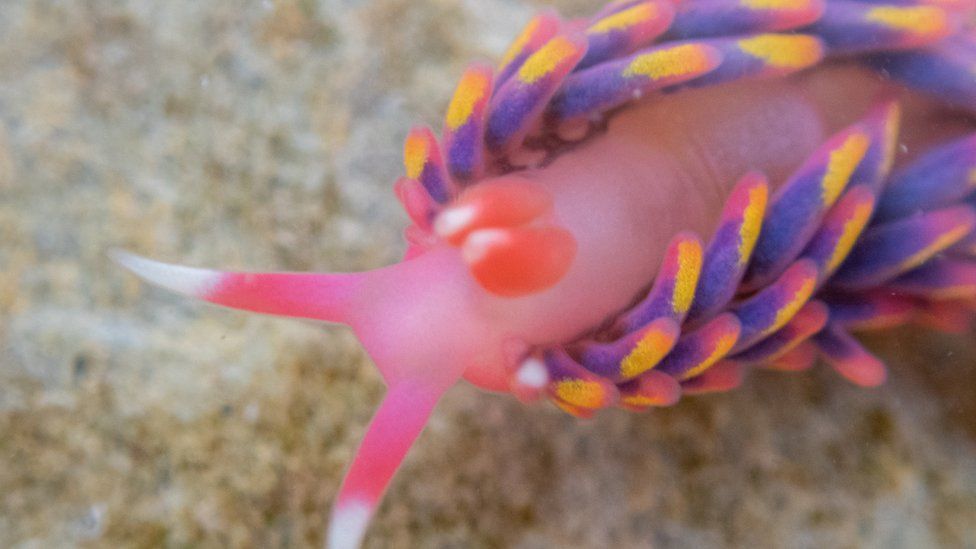
Update and Rainbow sea-slug found in rock pool

Sorry for the quiet over the last week, we have been working hard on improving various sides of the website. Firstly, you should find that the menu is easier to use, whether on mobile or a desktop computer. Secondly, a lot of work has gone into the species watch tab. Now all currently listed animals has a page associated, we still need to find more people to help with visitors, but progress is being made.

Do consider joining us, the task is huge.

this creature, more commonly found around Portugal, was found in a farnmouth rock pool Photograph: Vicky Barlow Ltd/Vicky Barlow / @thehidephotography

This creature has been seen off the coast of the UK by divers and snorkelers, but it is thought to be the first time that one was found in a UK rock pool. This is just more signs of our warming planet.

The occasional visitor may not do damage, but it is very possible that if the seas continue to warm enough might arrive to start damaging the prospects of other native wildlife.

See Animals Wild

Read more news

Join as a wild member
to list your wild place & log in

Join as an ambassador supporter to
support this site, help save wildlife
and make friends & log in

Join as an Associate member
to assist as a writer, creator, lister etc & to log in

List a wild destination

List a destination in
the shadow of man

List a hide for animals more easily seen this way

Highlight some news
missed, or submit a
one-off article

Browse destinations for fun or future travel

Temporary membership
start here if in a hurry

Casual readers and watchers