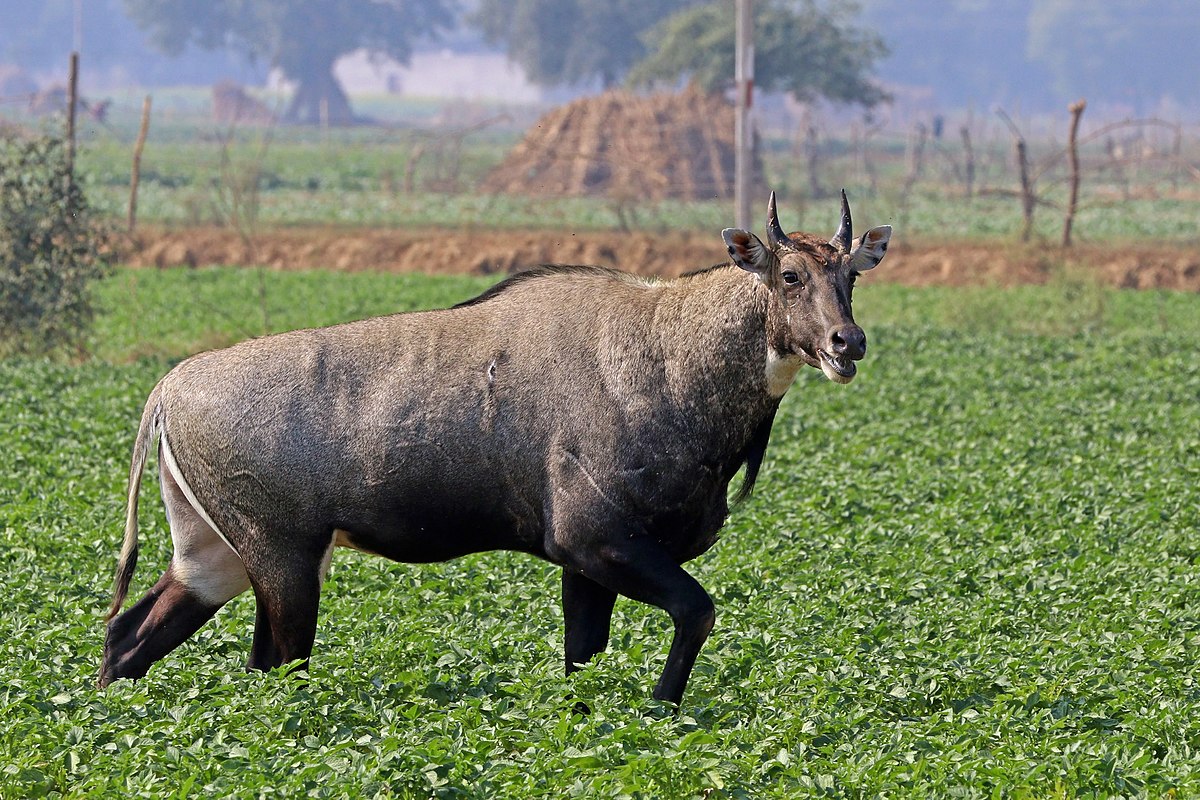
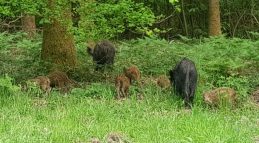
The Nilgai – the name translates to blue cow (it appears to be an amalgamation of Nil and Gai from Hindi), is the largest antelope to be found in Asia (both species of Eland and the roan antelope from Africa are larger). It is the sole member of the genus Boselaphus (as well as being only 1 of 2 species in the tribe Boselaphini.
Typically found either in mothers and small calf group, mothers and older calf groups, or bachelor herds. They generally have a lifespan of around 10 years. Preferring areas with scattered small bushes and trees, they are found in Indian and Nepal Terai which is a lowland area with long grass, and rich savannah. There is also a feral population in Texas, which numbers 37,000. They are not endangered at the current time.
They damage crops, which leads to them being classed as vermin in parts of their range.
The Indian population is estimated at 1 million. It is widespread in Northern India, which means that it is found in many of the best known tiger reserves, but these 2 are examples Gir National Park (Gujarat); Bandhavgarh National Park.
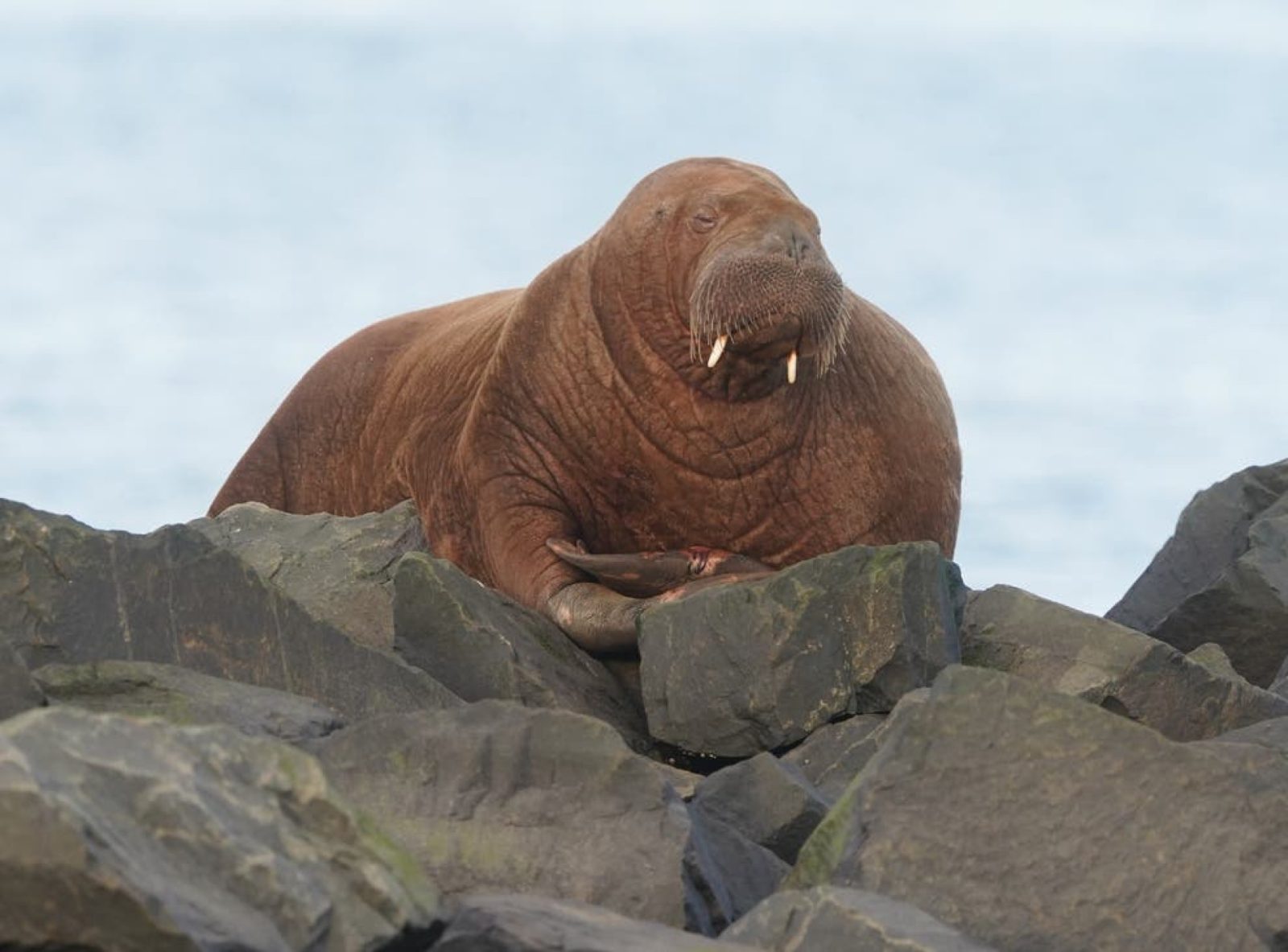
The Walrus is a fascinating species that lives in the area around the north pole. This one was photographed in Holland. In a similar way, they are infrequent visitors to the UK. Having said this, they used to be resident in Scotland, with the last dominant male and his harem being killed in 1850. There are occasional talks about reintroducing them, and they would likely be the easiest member of carnivora to return to our crowded island.
There are 2 subspecies of the Walrus, the Atlantic walrus and the Pacific walrus. Currently, these animals number in total 250,000 but before exploitation there were thought to be a high of 200,000 Pacific Walrus and the Atlantic Walrus population merely estimated to be in the hundreds of thousands. While now having been subspecies for quite some time, the two are only thought to have diverged 500,000 to 750000 years ago.
While its current distribution is clearly very centred around the north pole, they roam widely. They used to be found in the UK until around 1850, and several have spent time around the UK in the last few years. The picture above is that of wally the Walrus resting in Cornwall. of course to see these animals in their element, it is worth going north.
Below is a video from planet earth, showing an exhausted polar bear, trying to predate walrus. This move is a clear act of desperation, as while one on one, a polar bear might manage to take a large walrus, attacking a herd of walrus is a quite different matter.
Below that is a list of articles which have been written on this species within this website. While currently, there are not many, we hope to add more in the future. If you study them or similar, do get in touch as we would love to feature articles from the field.
Below both of these, we aim to start adding places where you can see walrus in the wild.
Incredible hunters, they are important for controling populations in this area. Photo credit:Gregory "Slobirdr" Smith
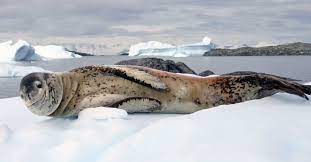
Leopard Seal
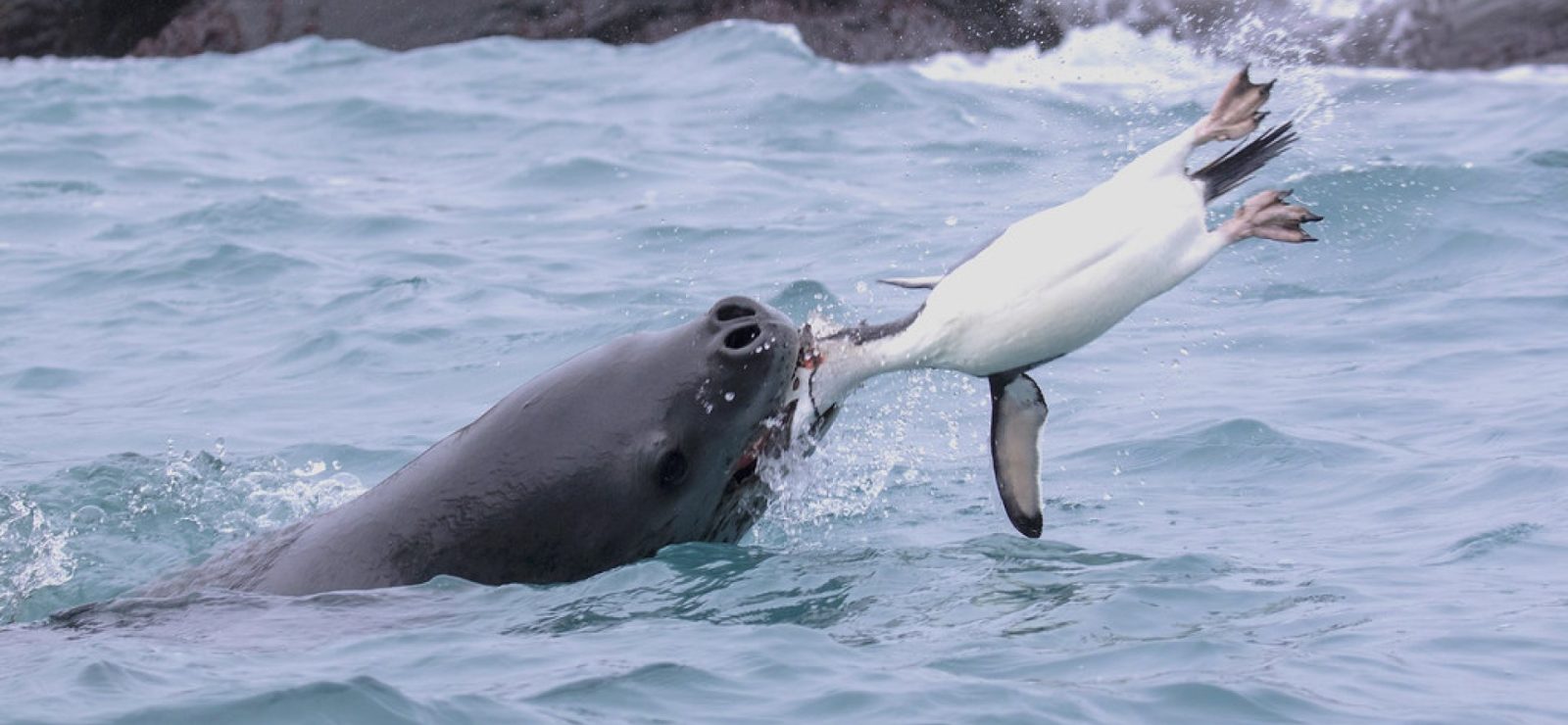
This seal is the second largest (after the southern elephant seal) to be found in the Antarctic ocean. It has a wide ranging diet, which includes cephalopods, other pinnipeds (i.e. seals and similar) krill, fish, cephalopod and birds with a specific interest in penguins; indeed unlike other members of the seal family, leopard seals also feed on other marine mammals. Most commonly, they may eat crabeater seals, Weddell seals, and Antarctic fur seals. Indeed, the leopard seal is considered an apex predator, with the ability to control populations of various species. Its only predator is the Orca, and large sharks.
It was first scientifically described in 1820. While naturally found only around Antarctic, they have been noted to wander as far as New Zealand and Australia. Except pups with their mother, they live solitary lives, and are thought to number 220,000 to 440,000.
The most common view of a leopard seal, but like the leopard often seen up a tree, this is not where they are dangerous
Being large hunters, they can pose danger to humans, though attacks on humans are rare.
They live for up to 26 years, and are thought currently relatively stable as a species, though their reliance on the ice floes around Antarctica may prove a threat to the species if climate change continues unabated for some time further.
It is well worth seeing this species, and we hope to list places where you might actually find them in the wild. Do get in touch for us to add your guiding/boating or whatever, which will allow people to see this species in the wild
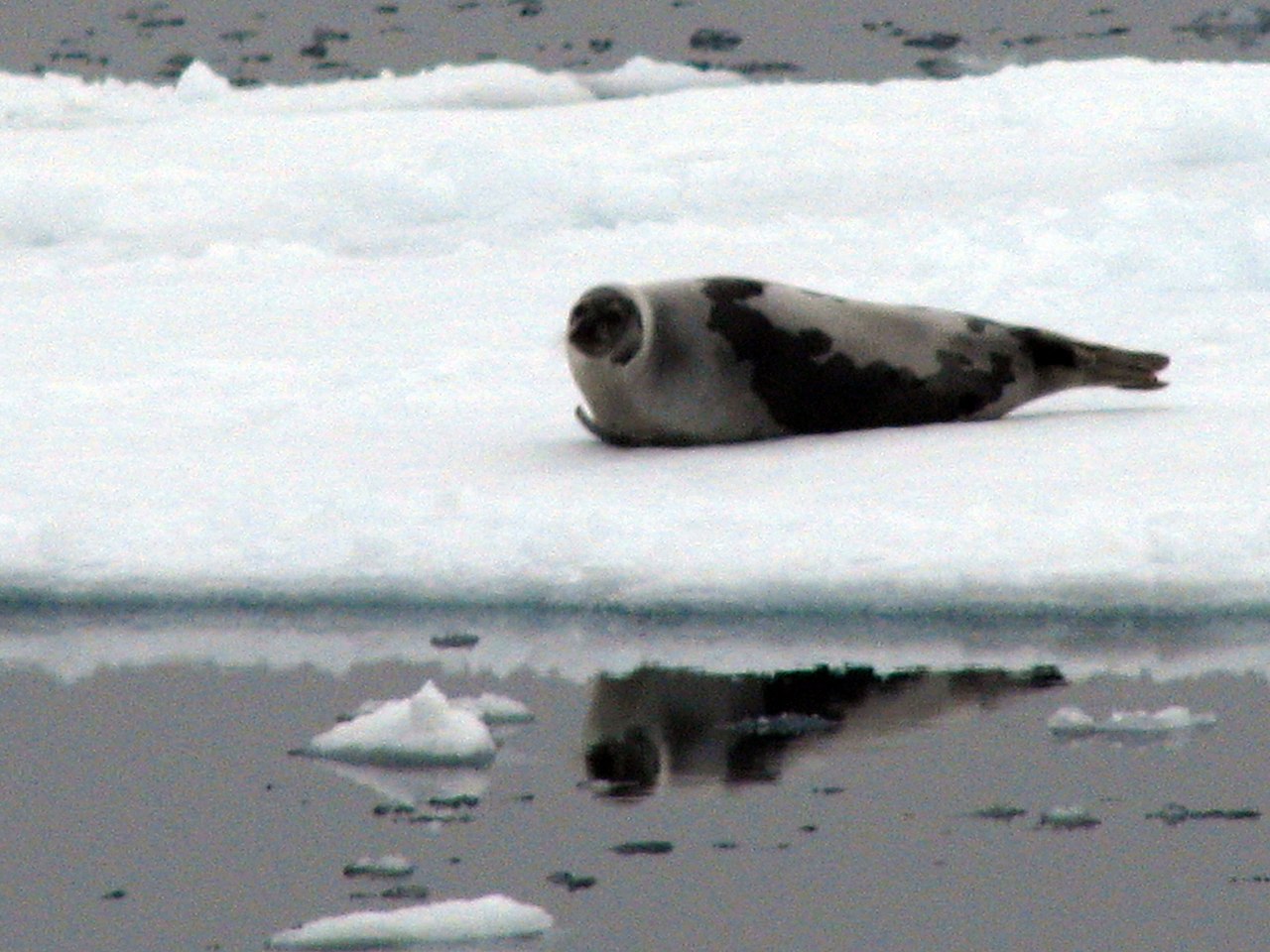
Also known as the Saddleback seal, or the Greenland seal, the harp seal spends most of its life at sea.
Harp seal
Thankfully it is a fast breeder, and is therefore capable of bouncing back fast.
They have a global population of around 7.6 million, and there are 2 recognized subsepcies. They migrate long distances (as much as several thousand miles, but unfortunately all 3 populations are hunted by various countries.
In the past, that hunting quota has had horrific effects on population size, with it being as low as 1 million and as high as 9 million at different times in the last 150 years. These days the quota is worked out scientifically, which has stopped human caused seesaw of the population size.
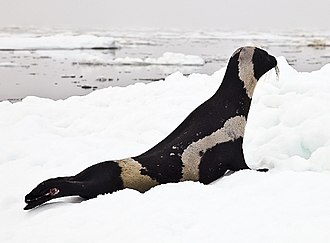
The ribbon seal is a mid-sized seal species found throughout the Arctic and sub-arctic.
Young ribbon seals look like young harp seals. In the past, they were hunted too close to extinction, but Russia banned their hunting in 1969 and the population has bounced back to 250,000.
In March 2008, the USA government considered listing this species on the endangered list, unfortunately the government decided that climate change did not threaten the sea ice to remain – as a result they decided not to list the species IT IS TOTALLY RIDICULOUS THE USA GOVERNMENTS POSITION. In 2009 it was sued to reconsider, and in 2013 it decided once again that listing was not required.
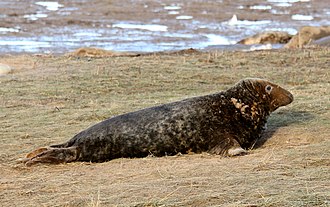
There are 2 recognized subspecies, one in the Baltic sea and the other in North west and east of the Atlantic (this is the other common species found in UK waters.
There are a number of well known breeding colonies around the coast of the UK. Notable colonies in the UK, include Blakeny point in Norfolk, the Farne and Orkney islands. There is also colonies around the USA and Canada.
Around much of the world, the primary hunter is the Orca, though there are also a variety of sharks that will also take one if given the chance. Recent observations have also shown that they take harbour seals and porpoises if they get the chance.
There has also been a significant level of cannibalism where male seals kill pups of its own species.
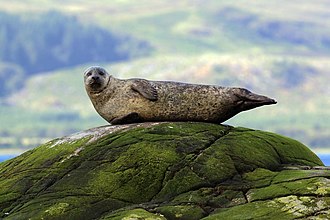
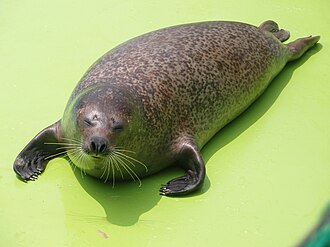
The harbour seal is hugely widely spread around the northern hemisphere. Indeed, it is the widely spread pinniped species, found around the north of the Atlantic, Pacific Baltic and North seas.
Also known as the Larga or Largha seal, it is considered a true seal which inhabits the ice floes of North pacific ocean. There is a fear that global warming might reduce ice floes and therefore end this population, but thus-far it does not appear to have had any impact.
The bering sea population currently number around 100,000, with a second population of 100,000 in the sea of Japan. A third population of 3300 live in the LIadong bay in China,
It is not currently thought that climate change will impact sea ice enough to threaten the population in the near future.
One of the smallest seals, it is found exclusively along the shore and in the very salty Caspian sea. Evidence suggests that like similar populations, seals initially migrated along rivers, which have now ceased to exist, cutting them off from the rest of the world.
The caspian seal
At various times, illnesses like canine distemper has swept through the population, killing thousands, but thankfully never wiping out the whole population.
100 years ago, the seal population was around 1.5 million. Through various problems from humans, such as reducing fish stocks, and various illnesses this population has dropped to its current level of around 70,000.
Increasing industrial activity has lead to an increase in chemicals that damage the seals in the water. It is thought that this is having an impact of reducing the seals capacity of fighting off diseases.
Sea eagles do predate young, and are known to kill quite a few.
A die-off of around 2500 happened in December 2022. At this time, it is not clear what caused this.
The Baikal Seal is only found in lake Baikal in Siberia, Russia. Like the Caspian seal it is related to the Arctic ringed seal. It is also the only exclusively pinniped fresh water species (there are other species which have subspecies which live in fresh water, but none where the whole species lives this way. Currently, there are 80,000-100,000 seals in the lake, which is the calculated carrying capacity. As such, they are not considered endangered at all.
It is unclear how seals got to the lake, though they may well have lived in the lake since it was connected to the sea, some 2 million years ago.
There is a small quota which is meant to not effect the population. While the quota may not, poaching is thought to be at least several times the amount of legal hunting, meaning that this should be taken into account but probably is not at the current time.
The biggest threat, is likely to be climate change, and warming waters is likely to have a big impact on a closed water system like this.
Seals are able to suckle for as much as 3 months, which is far more than many species. They keep growing until 20-25 and often live to 50 years old – a very impressive age compared to many other species.
Beneath this, we have a video of this species in the wild, and beneath this is a list of any articles which have been written on this species (there may as yet be none, but this will hopefully change in the future).
We are also keen to help wildlife be of value to people who live nearby, so at the bottom of the page, we are keen to list any links that will help people book to see this species in th wild.