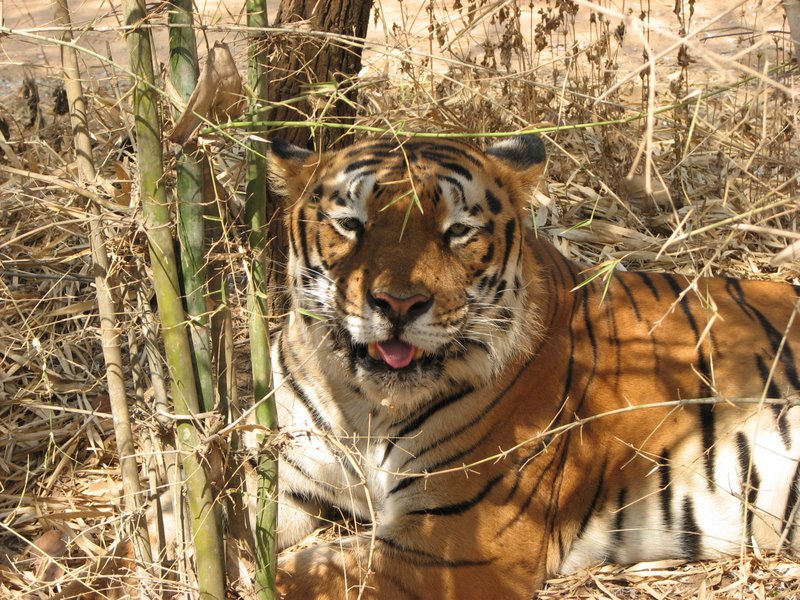
Bhutan is a mountainous country, thought to have a small population of tigers. Tigers have been photographed thousands of meters up mountains, and is the only country where this is known to happen. In 2014 a census counted 103 tigers, up from the previous estimate of 75.
There appear to be no further census done. It is entirely possible that Bhutans tiger population has increased, but we cannot know.
Rabbits are not native in the UK. They were introduced about 1000 years ago. the first Myxomatosis outbreak in the uk was in 1953. There have been various foolish uses of this disease (the Iberian Lynx is largely only threatened with extinction because it relied heavily on rabbits for food, and these disappeared when myxomatosis was introduced.
Hares are a native species, so it is of greater concern if they are being eradicated. More than 1100 hares have been identified as having died from this, over the last 4 years. Now, as they currently have a population of more than 800,000 individuals, this is not currently a big concern. However if the outbreak has a similar impact to rabbits, then hares could disappear from parts of the UK.
It is already thought to have lost 80% of its population over the last 100 years.
Unfortunately, with our modern habit of farming breeds of wild species, we are giving perfect conditions for new viruses to appear.
For years it has been assumed that it is a mixture of these two reasons that red squirrels survive but perhaps not
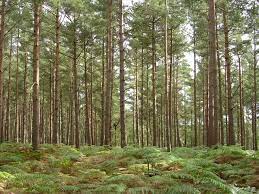
Food sources in conifer plantations tend to be smaller, limited to small cones and such like. As such, this suited the smaller red squirrel more than the invasive grey. However this has recently been thrown into doubt.
Where as, in broadleaf tree plantations there are a variety of food sources for pine martens and so red squirrels will not be exclusively predated, in conifer forests with less food to find red squirrels are hunted more often.
This research is based on 5 years of observations from the public and camera traps. It was carried out in northern Ireland, and looked at pine martens red and grey squirrels.
In natural woodlands there is a diverse range of prey and plenty of refuges for red squirrels, however in conifer plantations pine martens will eat far more squirrels because there is little else for it to find.
We therefore need to stop replacing large areas of natural wood with plantations.
If this is true, then the pine marten has even more pressure on it, as it must drive the grey squirrel out so reds can survive. A recent study of grey squirrels dna shows that the UK population relies far more on humans. Far from colonising the country they appear to have been moved by humans and installed in new parts of the country on many occasion. One example, showed this by the fact that the grey squirrels around Aberdeen appear to have originated with the population around the new forest.
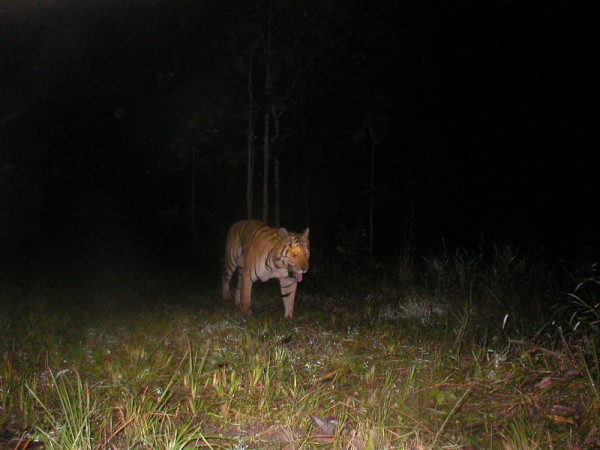
Unfortunately below is the last known sighting of a tiger in Cambodia from 2007
AreTiger (Panthera tigris) walking at night, taken by camera trap in Mondulkiri protected forest of Eastern Plains Landscape, Mondulkiri province, Cambodia. WWF-Cambodia has set up a camera trap in Eastern Plains Landscape since 2002, but only two photographs of tigers have been captured. The first was captured in 2004 and the next in 2007.
With no confirmed sightings since, it is thought that the cambodian tiger is gone. There are plans and conversations going on about reintroducing it -hopefully I can write an article on this in the near future.
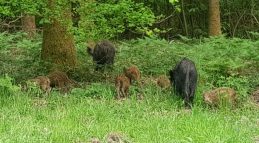
Wild boar are the wild ancestors of the modern pig. This is why pigs and boar can interbreed – The domestication occurred in Europe, but started about 9,000 years ago, about 3000 years after we started farming crops. It appears to have happened slowly over time, not all at once as some other domestication moves have been. It is thought that this process started in Turkey, and a couple of millennia later in China. There is some evidence that it also occurred elsewhere in Europe.
The modern pig appears to be descended from a variety of different species of wild boar, suggesting a certain amount of mixing of the different domesticated pigs. It is also clear that human preference had a great impact, as very similar pig like animals appeared in several different parts of the world independently.
In the UK, wild boar populations have accidently been created. These have grown fast, and are currently requiring big culls most years. I would like to see some of these boar moved rather than being killed. Forests with wild boar in, are far more healthy with more young saplings naturally sprouting. I believe that we should accept that the boar is back and reintroduce it into every significant area of woodland in existence.
It is true, that they can be dangerous however so can deer. As with all wild animals, provided you do not get too close you should be fine. Now I would argue that natural predators would be the best control on numbers, but I think in the UK we are not there yet.
In 2011 vietnams population of tigers was estimated at 20. These are of the Indochinese sub species, unfortunately with only around 350 left across all countries it lives in, this sub species could still be lost. It should be noted, that the last photo was in 1997, and it is considered functionally extinct.
Given populations of tigers in nearby countries, if Vietnam improves its forest health the tiger is likely to return on its own in due course.
Unfortunately, there is little more to say about the tiger in Vietnam
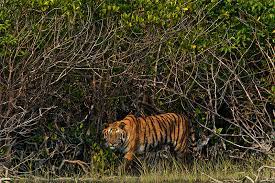
It appears that there are only 2 different areas of Bangladesh which still hosts tigers. These include the Sundarbans, an area of mangrove lying between India and Bangladesh and the Chittagong Hills Tract where photographic proof of a tiger has been taken. Unfortunately, though there are tigers in the Chittagong hills tract, it is unlikely going to be more than a few.
While not the habitat people think of, tigers are clearly doing alright in the Sundarbans. The habitat clearly has space for more, but with humans incursions it may never grow much.
There is still some argument about how many tigers call the Sundarbans home. 114 tigers were identified, however as this survey only looked at about 16% of the forest it is reasonable to presume there are more. If all areas of the Sundarbans have similar densities of Tigers, we can estimate the whole population at about 700. Assuming this is prime habitat, the original number of 400-500 seems reasonable.
My judgement is that the tiger population has grown. I suspect that it has not doubled, but it has increased. I suspect that there is still significant poaching, but with continued efforts these tigers could recover.
We have watched with horror, the problems that Myanmar has suffered over the last few decades. Perhaps one of the positives though is the fact that often when this sort of thing happens ecosystems are given time to recover.
This appears to be the case in the the snowy north.
40 different large mammals were sighted on the camera traps. These include Red pandas dholes Shortridges langurs and takins. As a result of the study, a recommended southern extension of a local national park, could protect this special area.
Clouded leopards are also present (a species that could encourage tourists to come and visit).
With few roads in the area, at the moment it is only accessible after several days hiking through unforgiving terrain. This has protected it from destruction, but also from discovery.
We must just hope and put pressure on Myanmar to protect this area before it is destroyed.
Today and over the next few days, I am going to try to do an overview of how the 12 tiger range countries have managed in their target of doubling tiger numbers in the last 12 years.
In 2010 it is estimated by WWF that India had 1706 tigers living wild within its borders. There are now estimated to be roughly 2967, which would mean an impressive growth but not meeting the doubling goal they have however claimed to have met it (often with lower starting figures). Still a population increase of 72% is not a bad showing in just 12 years. I should note that this number of 2967 is also listed on many pages as the number of tigers in 2018. So it is possible that they have increased the number further over the last 4 years – data is hard to find. One positive point for the future is currently wild tigers only live in about 10% of the potential 115,830 square miles of habitat. Either way, the Indian country is not satisfied with this number, and are aiming to increase numbers by a further 35%. One thing that has been recognized, is that reserves missing apex predators do not do as well. This is for a variety of reasons, but the main ones come down to regulating availability of grazing for too many herbivores. Mizoram’s Dampa reserve, West Bengal’s Buxa reserve and Jharkhand’s Palamau reserve are three tiger reserves within India which have no tigers.
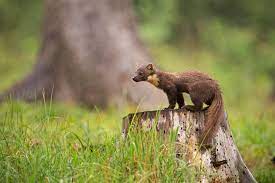
Pine martens are an important part of the UK ecosystem. Indeed, it is only through their absence that the grey squirrel was able to get a foothold. Might this pine marten group return to save the red squirrel and remove the grey?
This video was filmed a few months ago
Pine martens are very good for the UK. It is the reason that red squirrels are so acrobatic – it is the only way to avoid this arboreal predator.
It is not thought that this population can be large, but its size is being studied.
If they are given the space to survive and thrive (it is probably necessary to translocate a few more) they could be really good for the forest.
Grey squirrels only arrived in the new forest in 1940s, and if this arboreal predator gets fully re-established, it is likely that the grey squirrel will disappear once again. This would then allow the return of the red squirrel. There is a red squirrel colony on Brownsea island, which is likely to benefit from the pine martens return, as they will greatly reduce grey squirrels in the area.