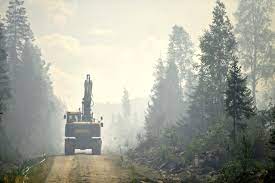
A large portion of Sweden is covered in forest. While native trees are grown, these vast plantations are actually cut down regularly. Given it may take a few decades for trees to grow to maturity, much of the country is left pretty wild.
Although much of Sweden looks wild, the forests are regularly cut down for timber. Still the forests support a healthy population of bears, and a growing population of wolves
While the Swedish people are quite keen hunters, there are significant numbers of bears, and even a small but growing population of wolves.
This is why it is so worrying to find that some of the wood in their products actually came from protected forests in Russia.
It was as much a surprise to Ikea as to us, and they have cut off deals with the company at fault.
This just highlights the incredible difficulty in making sure your products are completely clean. Never-the-less a similar mistake in the near future might have a bigger impact on their reputation, they must increase the level of their due diligence.
With an endowment, to rival a host of small countries, the clout that Harvard should have in terms of divesting from fossil fuels could be vast.
Unfortunately they are dragging their feet. Apart from the bad look that this give, it is also a highly dangerous way of working – there is an increasing concern that many fossil fuel companies will be left holding vast rights to drill will be worthless as they wont be able to sell the oil.
If all cars and lorries go electric (and it is looking increasingly like it will, and faster than expected) this will cut out the bottom of the oil market. Also with kites and sails, ships are increasingly going electric and renewable, and even planes are getting in on the act oil might become less and less useful.
It has already been shown, that it is cheaper to set up a solar or wind farm than it is to continue to burn coal or oil until the end of the powerplants life – as the numbers move even further, it is going to become impossible to ignore.
In 2016 a special type of bacteria was found on a Japanese dump. While incredibly fast progress is being made, experts warn that their use is still probably years away. The other concern, is that they may leak into the environment. If this were to happen damages could be incredible.
A company owned by the Pahang states royal family plans to mine iron ore from a forest reserve that currently hosts a variety of important mega fauna, including tigers elephants sun bears and leopard.
While proportionally a small percentage of human emissions, the emissions of seafaring trade currently amounts to roughly 2% of our emissions.
The thing is, that with the huge advances in wind technology it would be possible to save a great deal of money and emissions.
A recent test of a ship kite, was found to save 10-15% (the creater of one of these systems suggested saving of 20% or more) of the fuel per day, a saving of $1000-1500 – which is quite something. While the kite systems currently cost a million or so, this will still be paid of in a couple of years. Furthermore this price is likely to fall as the technology becomes more mainstream.
In past governments indigenous land was out of bounds, yet under Bolsonaro there is currently 1265 requests to mine in Indigenous territories pending. This behaviour is prohibited by the Brazilian constitution, which shows how bad this is. If the mining is illegal what is the ned for it to even be looked at?
Given in these cases this land has been given over to the tribes, it is not the governments to hand over to miners.
The big concern is that even if Bolsonaro is voted out after just one term, he may have destroyed most of the countries remaining forests and indigenous areas, meaning there will be little for his replacement to save.
One of the companies wrote to Mongabay after the article was originally published, they claimed that they did not know anything about it. Unfortunately the record of the request is clear, and it is worth noting that while denying the existence, they did not cancel any of the requests at all
Jair Bolsonaro and his supporters are getting frustrated. The whole world can see that the direction the country is taking is extremely dangerous. Rather than changing tack they have decided to silence the detractors.
Whether environmental researchers, academics or officials, it seems that no one is safe. Increasing numbers of these professions are being forced to seek safety abroad to avoid threats to their lives.
This is not the behaviour of a democracy leader, and it wont work
The human race has been emitting carbon at an extreme rate for several centuries. Before we started burning things for the energy locked up inside them, the worlds carbon sinks and its carbon taps were in relatively stable harmony. For long periods of the earths existence, carbon absorbed by plants equalled the carbon emitted by breathing and volcano eruptions among other sources.
There are a variety of other carbon sinks. The earths oceans absorb carbon, while they can absorb huge quantities of carbon, this acidifies the water, which means that we dont want to rely on that to to great an impact.
The last time that I wrote about a potential Airline disrupter was back in late March. Interestingly, the source article was written back at this point but I didn’t find it for a few months.
In this case, the change is in design rather than in the fuel (the last article on planes was looking at using biofuels made from algae. I should note, that this is probably possible to power any aircraft, so both changes could team up.
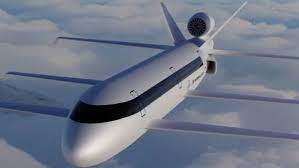
In this case, rather than changing the fuel, the layout of the plane was changed. Rather than 1 relatively thick wing, they replaced it with 3 thin wings distributed along the body of the plane.
By having 3 sets of narrow wings, each part of the plane is supported.
One of the main advantages of this design, is that there is no natural rotating point. Generally the tail of the plan is required to keep the plane flying level (this tail is recognized as one of the most problematic parts of the plane in terms of efficiency).
Why is this design exciting? Well this plane would have a carbon footprint 70-80% lower than current aircraft. This means that it is incredibly cheap to run, and therefore cheaper for passengers to fly on. Also of interest is the fact that this design makes the aeroplane far safer. Due to its higher efficiency it can also fly an incredibly long way – 10,500 miles, far enough to easily fly London to Australia ( this would suggest that perhaps in the future, non stop flights to new Zealand are not too far off). Another advantage, is that due to its low drag coefficient, it would fly at 690 miles per hour (mach 0.9) – more than 100 miles an hour faster than normal passenger jets. In a similar way, London to Johannesburg would be a little over 8 hours.
So this plane would be cheaper to fuel, fly further and faster. It is predicted to be far cheaper to maintain, and to have a life span of twice current planes. It would have a wider body, so take more passengers than normal. It has a high lift coefficient, allowing it to take off from shorter runways, allowing it to access more of the world. Due to the how thing the wings are, they would not be able to store fuel anymore, so this would have to go in the proper body of the plane – current plans would be at the top of the plane over the passengers. As well as having a lifespan of roughly 50 years, it is thought that each plane will take half as long to build.
Whether we see an aircraft like this is anyone’s guess. Moving to one engine at the rear of the plane, probably rules out electric propulsion, though who knows. Of course with wings as slim as this it is unlikely to be able to accommodate dispersed power.
It is unfortunately true, that we are so close to climate disaster that we need all large countries to move as one on mitigating climate change. What is to happen if just a few refuse? An article from a few months ago spells this out, and its not good.
If ChinaRussiaBrazil and Australia all follow up on the pledges that they made on carbon reduction the world and the rest of the world followed their example, we as a planet would be looking at warming of 5°C rather the 1.5°C that scientists tell us is needed in order to avoid terrible impacts.